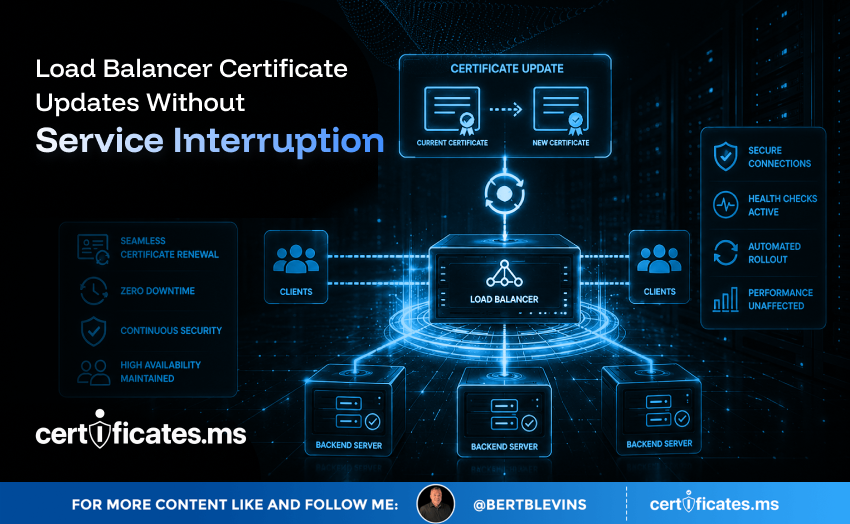
Load Balancer Certificate Updates Without Service Interruption
Several earlier articles in this series covered load balancer certificate best practices for specific platforms, HAProxy, NGINX, F5 BIG-IP. This article steps back to focus specifically on the general mechanics of updating a certificate on any load balancer without dropping a single active connection, a discipline that applies across virtually every load balancing technology regardless of vendor.
Why Certificate Updates Are Uniquely Risky at the Load Balancer
A load balancer typically sits in front of every request reaching an application, which means a poorly executed certificate update here has a considerably larger blast radius than the same mistake on an individual backend server. Understanding and applying zero-interruption update techniques at this specific layer deserves focused attention precisely because of how much traffic depends on it functioning correctly through every single renewal.
The Core Technique: In-Memory Hot Reload
Modern load balancers and reverse proxies generally support reloading TLS configuration, including a newly renewed certificate, into a running process without terminating existing connections or requiring a full service restart. This works by having the load balancer’s control process load the new certificate into memory, direct new incoming connections to use it immediately, while allowing already-established connections to continue running against whatever certificate context they started with until they naturally complete, avoiding the abrupt connection termination a full restart would cause.
Connection Draining as a Complementary Technique
For load balancer architectures where a hot reload is not fully supported, connection draining offers an alternative path to zero-interruption updates: new connections are directed to an updated instance already running the new certificate, while an old instance still serving existing connections is allowed to finish those connections naturally before being taken out of rotation entirely. This pattern is especially common in cloud-native load balancing setups where instances can be added and removed from a pool dynamically as part of the update process.
Blue-Green and Canary Approaches for Higher-Stakes Updates
For particularly high-stakes services, some organizations apply a blue-green deployment pattern specifically to certificate updates: standing up a fully separate, parallel load balancer instance with the new certificate, verifying it functions correctly against real traffic at a small scale, and then shifting traffic over gradually or all at once once confidence in the new instance is established, keeping the old instance available briefly as an immediate rollback option if anything unexpected surfaces.
Verifying the Update Actually Succeeded
A certificate update that completes without any visible connection drop is not automatically a successful update; it also needs to be verified as actually serving the new, correct certificate rather than a stale cached version or a partially applied configuration, using the independent chain-verification approach discussed in the production debugging article elsewhere in this series, applied specifically as a standard post-update check rather than an occasional troubleshooting step.
Fleet-Wide Consistency During Rolling Updates
Organizations running multiple load balancer instances behind a shared configuration, whether for high availability or geographic distribution, need their update process to roll out across every instance and verify success on each one independently, rather than assuming a successful update on one instance implies success everywhere, a specific risk discussed in the earlier F5 BIG-IP certificate management article in this series that applies equally to any multi-instance load balancer deployment.
Applying These Techniques to AI Inference Load Balancing
Load balancers fronting AI model inference endpoints, discussed elsewhere in this series, benefit particularly from these zero-interruption update techniques given how sensitive many AI-serving workloads are to even brief connection interruptions during periods of high, bursty request volume, making a dropped-connection certificate update considerably more visible and disruptive for these workloads than for more evenly distributed, predictable traditional web traffic.
The Countdown Is Already Running: 200 Days, 100 Days, 47 Days
Every certificate conversation in 2026 eventually arrives at the same clock, and it is worth closing on it here. The CA/Browser Forum’s Ballot SC-081v3 is not a proposal under discussion; it is an approved, already-in-motion schedule. Maximum public TLS certificate lifetimes fall from 398 days to 200 days on March 15, 2026. They fall again to 100 days on March 15, 2027. By March 15, 2029, they drop to just 47 days, with domain validation itself needing to be re-proven roughly every 10 days.
Translate that into operational terms and the picture gets stark quickly. An organization currently renewing certificates a few times a year will be handling renewal events on the order of every couple of weeks by the end of this countdown, across every endpoint it operates. Manual tracking, calendar reminders, and a spreadsheet somebody checks once a month will not survive contact with that cadence. What has always been an occasional chore is becoming a continuous, automated operation, whether an organization plans for it or not.
Zero-interruption update techniques become an operational necessity rather than a nice-to-have as the schedule below compresses renewal cycles toward every 47 days, since a load balancer update process that drops connections occasionally at today’s renewal frequency will produce a correspondingly higher number of visible disruptions once renewals happen several times more often.
The 200-day, 100-day, and 47-day milestones are not distant hypotheticals; the first has already arrived. Organizations that build the automation loop now, generating keys, vaulting them securely, brokering issuance across Certificate Authorities through APIs, and rebinding certificates to live endpoints without manual intervention, will meet each deadline without disruption. Organizations that wait will be rebuilding their certificate operations under deadline pressure, with far less room for error and far less time to get it right. The countdown is the call to action. The only real decision left is whether to automate on your own schedule, or on the CA/Browser Forum’s.