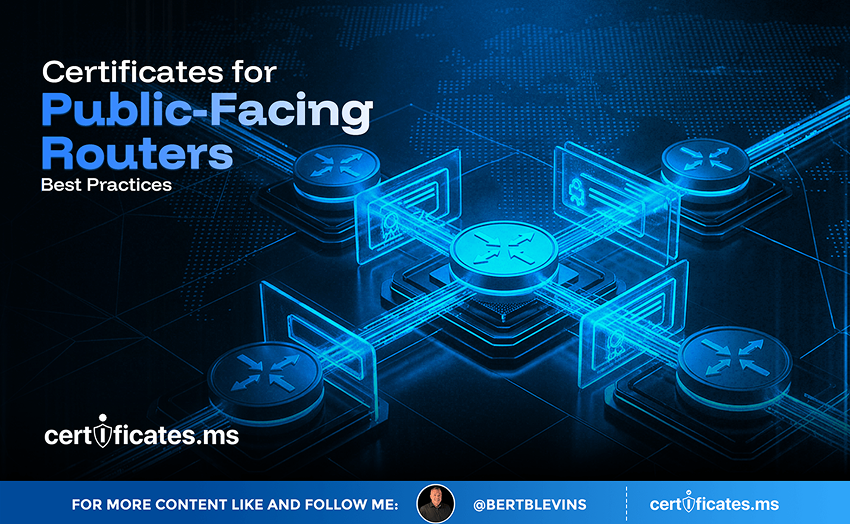
Certificates for Public-Facing Routers: Best Practices
Routers and other network edge devices sit in an unusual position in most organizations’ certificate inventories. They are critical infrastructure, they are often internet-facing, and they are frequently managed by network engineering teams working somewhat separately from the security teams who own broader PKI strategy. That gap creates real risk. This article covers the best practices that keep public-facing router certificates from becoming the weak link in an otherwise solid security posture.
Why Router Certificates Deserve Special Attention
A public-facing router often exposes a management interface, a VPN endpoint, or an administrative console directly to the internet, protected by TLS. If that certificate is weak, expired, or self-signed without proper distribution to trusted clients, attackers gain an obvious target: a device sitting at the network’s edge, controlling traffic for everything behind it. Compromise a router’s management interface and an attacker potentially gains a foothold with visibility into, or control over, everything that device routes.
Avoiding Self-Signed Certificates on Management Interfaces
Many routers ship with a default self-signed certificate for their administrative interface, intended purely as a stopgap until a real certificate is installed. Leaving that default in place trains administrators and users to click through browser security warnings routinely, a habit that quietly erodes the entire point of certificate validation. Every browser warning that gets dismissed out of habit is a warning that will also get dismissed the one time it actually matters. Replacing default self-signed certificates with properly issued ones, whether from a public CA for internet-facing management or an internal CA for administrative access restricted to trusted networks, should be a standard step in router deployment, not an optional hardening measure.
Choosing the Right Certificate Type for the Interface
Not every router interface needs the same certificate strategy. A management interface reachable only from an internal, restricted network can reasonably use a certificate from an internal CA, since the pool of relying parties is entirely under organizational control. A router exposing a VPN endpoint or any interface reachable from the broader internet should generally use a certificate from a publicly trusted CA, since external users or partner organizations connecting to it will not have the internal CA’s root certificate installed and trusted by default.
Automating Renewal on Network Devices
Network hardware has historically lagged behind servers in supporting modern automated certificate issuance, and many routers still require certificates to be manually generated and uploaded through an administrative interface. Where automation is supported, whether through ACME clients, vendor-specific APIs, or centralized network configuration management tools, it should be used, since manual certificate renewal on network devices is a common and entirely preventable cause of unplanned outages, particularly for devices that are not checked as frequently as customer-facing web servers.
Hardening the Broader TLS Configuration
A properly issued certificate does not automatically mean a properly secured interface. Router administrative interfaces should be configured to reject outdated TLS versions and weak cipher suites, the same baseline hardening expected of any modern web server. Older router firmware sometimes defaults to legacy TLS configurations for backward compatibility, and these defaults should be reviewed and tightened as part of any certificate deployment, not left unexamined simply because the certificate itself is valid.
Inventory and Ownership Gaps
One of the most common failure patterns with router certificates is not a technical flaw but an organizational one: nobody owns the renewal responsibility. Network devices sometimes fall outside the certificate inventories and monitoring systems that IT security teams maintain for servers and applications, simply because network engineering manages them separately. Closing this gap means explicitly including network devices in whatever certificate discovery and monitoring tooling the organization already uses, so a router’s certificate does not silently expire simply because it was managed by a different team using a different process.
The AI-Driven Network Angle
As network operations increasingly incorporate AI-driven monitoring and automated configuration tools, these systems frequently need their own authenticated access to router management interfaces to pull telemetry, push configuration changes, or respond to detected anomalies. This adds another category of client relying on a router’s certificate configuration being correct, and another reason router certificate hygiene, once a narrow networking concern, has become directly relevant to the reliability of AI-assisted network operations as a whole.
The Countdown Is Already Running: 200 Days, 100 Days, 47 Days
Every certificate conversation in 2026 eventually arrives at the same clock, and it is worth closing on it here. The CA/Browser Forum’s Ballot SC-081v3 is not a proposal under discussion; it is an approved, already-in-motion schedule. Maximum public TLS certificate lifetimes fall from 398 days to 200 days on March 15, 2026. They fall again to 100 days on March 15, 2027. By March 15, 2029, they drop to just 47 days, with domain validation itself needing to be re-proven roughly every 10 days.
Translate that into operational terms and the picture gets stark quickly. An organization currently renewing certificates a few times a year will be handling renewal events on the order of every couple of weeks by the end of this countdown, across every endpoint it operates. Manual tracking, calendar reminders, and a spreadsheet somebody checks once a month will not survive contact with that cadence. What has always been an occasional chore is becoming a continuous, automated operation, whether an organization plans for it or not.
Public-facing router certificates are just as subject to the shrinking public certificate lifetime schedule as any other internet-exposed endpoint, which means network teams that have historically renewed these certificates by hand need to close that automation gap well before the 47-day cliff arrives.
The 200-day, 100-day, and 47-day milestones are not distant hypotheticals; the first has already arrived. Organizations that build the automation loop now, generating keys, vaulting them securely, brokering issuance across Certificate Authorities through APIs, and rebinding certificates to live endpoints without manual intervention, will meet each deadline without disruption. Organizations that wait will be rebuilding their certificate operations under deadline pressure, with far less room for error and far less time to get it right. The countdown is the call to action. The only real decision left is whether to automate on your own schedule, or on the CA/Browser Forum’s.