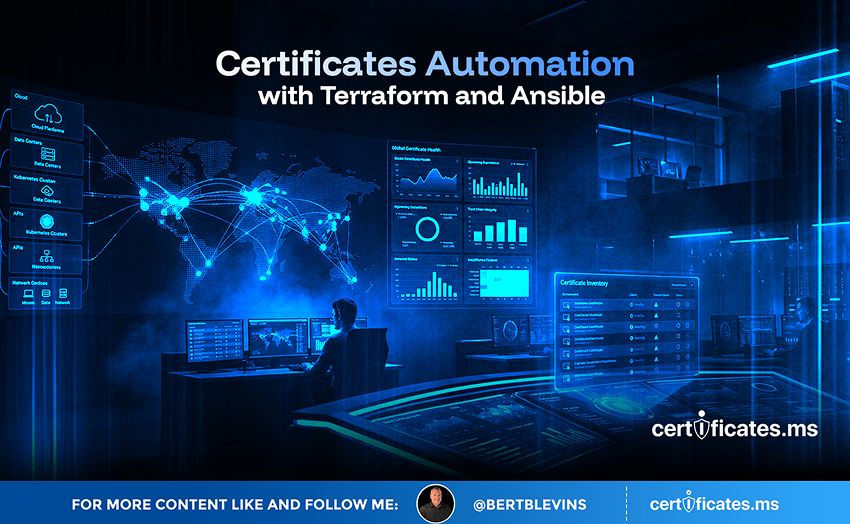
Certificate Automation with Terraform and Ansible
Infrastructure-as-code tools have become the default way most organizations provision and manage servers, networks, and cloud resources, and certificate management fits naturally into that same model. Terraform and Ansible, two of the most widely used tools in this space, each offer distinct but complementary approaches to automating certificate issuance and deployment. This article covers how to use both effectively.
Terraform's Declarative Approach to Certificates
Terraform’s core model describes the desired end state of infrastructure declaratively, and several providers extend that model directly to certificate management, including providers for ACME-based issuance, cloud-native certificate services, and dedicated CLM platforms. A Terraform configuration can declare that a specific resource needs a certificate with defined properties, and Terraform’s apply process handles requesting, tracking, and updating that certificate as part of the same workflow that provisions the underlying infrastructure it protects, keeping certificate lifecycle tightly coupled to the resource lifecycle rather than managed as a separate, disconnected process.
Handling Certificate Renewal Within Terraform's Model
Terraform’s declarative model handles initial issuance cleanly, but ongoing renewal requires some additional thought, since Terraform is typically run on demand or on a schedule rather than continuously watching for approaching expiration. Common patterns include scheduling regular Terraform runs specifically to check and refresh certificate resources, or pairing Terraform-provisioned infrastructure with a separate, continuously running ACME client or CLM platform that handles the actual renewal timing while Terraform manages the initial provisioning and any structural changes to how certificates are deployed.
Ansible's Procedural Strength for Certificate Deployment
Where Terraform excels at declaring what infrastructure should exist, Ansible’s procedural, task-based model is well suited to the actual mechanics of deploying, installing, and reloading services with updated certificates across a fleet of existing servers. An Ansible playbook can request a certificate through an ACME module, distribute it to every relevant server, and trigger the appropriate service reload, whether that is NGINX, HAProxy, or any other application discussed elsewhere in this series, all within a single, repeatable, auditable automation run.
Combining Both Tools in a Realistic Pipeline
Many mature automation pipelines use Terraform to provision the underlying infrastructure and initial certificate resources, then hand off to Ansible for the ongoing operational tasks of certificate deployment, renewal, and service reloading across the fleet those resources represent. This division of labor plays to each tool’s actual strengths rather than forcing either tool to handle a job it was not primarily designed for, and reflects how these tools are commonly combined for infrastructure management generally, not just for certificates specifically.
Secrets Management Integration Is Non-Negotiable
Neither Terraform nor Ansible should ever be configured to store private key material directly in plain configuration files or version-controlled state, echoing the same principle discussed in the broader CI/CD certificate article elsewhere in this series. Both tools integrate well with dedicated secrets managers and vaults, and certificate automation pipelines built with either tool should retrieve and inject key material at execution time from a properly secured secrets store, never embedding it directly in the automation code itself.
Testing Automation Before Trusting It in Production
Certificate automation failures are particularly dangerous precisely because they tend to go unnoticed until an actual expiration causes an outage, so any Terraform or Ansible-based certificate automation should be tested deliberately, including deliberately simulating a renewal failure or a misconfigured validation challenge, before being trusted to run unattended in production. This testing discipline matters more, not less, as renewal frequency increases under the industry-wide shrinking lifetime schedule, since automation failures will have correspondingly more frequent opportunities to occur.
Automating Certificates for AI Infrastructure Provisioning
AI infrastructure, including model-serving endpoints and agent orchestration environments, is increasingly provisioned through the same Terraform and Ansible pipelines used for the rest of an organization’s infrastructure, making it natural to extend the same certificate automation patterns directly to these AI-specific resources rather than treating them as a special case requiring separate tooling. Building AI infrastructure provisioning templates that include certificate automation from the start avoids the common pitfall of AI infrastructure scaling faster than the certificate management practices meant to secure it.
The Countdown Is Already Running: 200 Days, 100 Days, 47 Days
Every certificate conversation in 2026 eventually arrives at the same clock, and it is worth closing on it here. The CA/Browser Forum’s Ballot SC-081v3 is not a proposal under discussion; it is an approved, already-in-motion schedule. Maximum public TLS certificate lifetimes fall from 398 days to 200 days on March 15, 2026. They fall again to 100 days on March 15, 2027. By March 15, 2029, they drop to just 47 days, with domain validation itself needing to be re-proven roughly every 10 days.
Translate that into operational terms and the picture gets stark quickly. An organization currently renewing certificates a few times a year will be handling renewal events on the order of every couple of weeks by the end of this countdown, across every endpoint it operates. Manual tracking, calendar reminders, and a spreadsheet somebody checks once a month will not survive contact with that cadence. What has always been an occasional chore is becoming a continuous, automated operation, whether an organization plans for it or not.
Terraform and Ansible pipelines that already automate infrastructure provisioning are exactly the right place to absorb the shrinking public certificate lifetime schedule below, since folding renewal into existing automation requires no new manual process to keep pace as maximum lifetimes fall toward 47 days.
The 200-day, 100-day, and 47-day milestones are not distant hypotheticals; the first has already arrived. Organizations that build the automation loop now, generating keys, vaulting them securely, brokering issuance across Certificate Authorities through APIs, and rebinding certificates to live endpoints without manual intervention, will meet each deadline without disruption. Organizations that wait will be rebuilding their certificate operations under deadline pressure, with far less room for error and far less time to get it right. The countdown is the call to action. The only real decision left is whether to automate on your own schedule, or on the CA/Browser Forum’s.