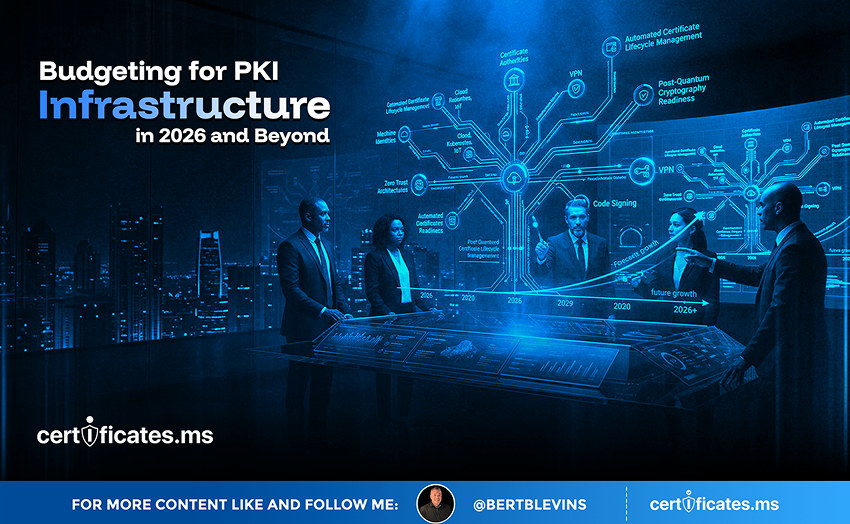
Budgeting for PKI Infrastructure in 2026 and Beyond
PKI budgeting has historically been an afterthought for many organizations, a small annual line item for certificate purchases with little further consideration. That approach is no longer viable given how quickly the underlying requirements are shifting. This article covers what a realistic PKI budget should actually include heading into 2026 and the years immediately following, when renewal frequency and machine identity volume are both climbing sharply.
Moving Beyond Certificate Purchase Price as the Budget Line
Historically, PKI budgeting often meant little more than estimating the annual cost of purchasing certificates from a chosen CA. As covered in more depth elsewhere in this series, purchase price is typically the smallest component of total certificate management cost, and a budget built around that single figure alone will significantly understate what a properly functioning PKI program actually requires going forward.
Core Budget Categories for a Modern PKI Program
A realistic 2026-forward PKI budget should account for several distinct categories: certificate costs across whatever mix of free and paid CAs an organization uses, CLM platform licensing or the engineering cost of maintaining an open-source alternative, secrets management and HSM infrastructure for protecting private keys, engineering time for initial automation implementation and ongoing maintenance, staff training, and a reserve for incident response should something still go wrong despite reasonable precautions.
Why the Shrinking Lifetime Schedule Changes the Math
The CA/Browser Forum’s approved schedule reducing maximum certificate lifetimes to 200 days by March 2026, 100 days by March 2027, and 47 days by March 2029 has direct budget implications: any cost that scales with renewal frequency, whether staff time under a partially manual process or platform usage costs tied to issuance volume, will increase substantially over this period even if the underlying certificate count stays flat. Budgets built without explicitly modeling this schedule will likely require unplanned mid-year increases as renewal frequency climbs faster than static, historically-based budget assumptions anticipated.
Accounting for Machine and AI Identity Growth
A separate but equally important budget driver is the rapid growth in machine and AI identities across most organizations, which is increasing total certificate volume independently of the lifetime schedule discussed above. Budgets should explicitly forecast expected growth in this category based on planned infrastructure and AI initiatives, rather than assuming certificate volume will remain flat simply because it has been historically stable, since that assumption is becoming less reliable every year as AI-driven infrastructure expands.
Building a Multi-Year Budget Rather Than an Annual One
Given how predictably the CA/Browser Forum schedule is already documented years in advance, PKI budgeting is one of the rare areas of IT spending where a multi-year forecast can be built with genuine confidence rather than speculative guesswork. Organizations should build out budget projections through at least 2029, explicitly modeling the cost trajectory of both renewal frequency and expected machine identity growth, rather than treating each year’s PKI budget as an isolated decision disconnected from the well-documented trajectory already set for the years ahead.
Making the Investment Case to Finance and Leadership
PKI budget requests land more effectively with financial decision-makers when framed against the concrete, already-approved industry schedule rather than abstract security best practice alone, since a documented, binding external deadline is considerably more persuasive to a finance team than a general appeal to improved security posture. Pairing the budget request with the ROI calculation framework discussed elsewhere in this series, showing avoided incident costs and labor savings against the investment required, gives leadership a genuinely complete picture for evaluating the request.
Budgeting Specifically for AI Infrastructure Certificate Needs
Organizations with active or planned AI initiatives should budget certificate infrastructure costs directly into those initiatives’ own planning, rather than treating AI-related certificate demand as an unplanned addition to the general PKI budget after the fact. Given how quickly AI infrastructure can scale certificate volume once deployed, building this cost consideration into AI project budgeting from the outset avoids the unpleasant surprise of discovering mid-project that certificate infrastructure needs a separate, unplanned investment to keep pace with the AI initiative’s actual growth.
The Countdown Is Already Running: 200 Days, 100 Days, 47 Days
Every certificate conversation in 2026 eventually arrives at the same clock, and it is worth closing on it here. The CA/Browser Forum’s Ballot SC-081v3 is not a proposal under discussion; it is an approved, already-in-motion schedule. Maximum public TLS certificate lifetimes fall from 398 days to 200 days on March 15, 2026. They fall again to 100 days on March 15, 2027. By March 15, 2029, they drop to just 47 days, with domain validation itself needing to be re-proven roughly every 10 days.
Translate that into operational terms and the picture gets stark quickly. An organization currently renewing certificates a few times a year will be handling renewal events on the order of every couple of weeks by the end of this countdown, across every endpoint it operates. Manual tracking, calendar reminders, and a spreadsheet somebody checks once a month will not survive contact with that cadence. What has always been an occasional chore is becoming a continuous, automated operation, whether an organization plans for it or not.
Any PKI budget built for 2026 and beyond that does not explicitly model the schedule below, 200 days, then 100, then 47, is working from an incomplete picture, since that schedule is the single most predictable, most quantifiable driver of rising certificate management cost over the next several years.
The 200-day, 100-day, and 47-day milestones are not distant hypotheticals; the first has already arrived. Organizations that build the automation loop now, generating keys, vaulting them securely, brokering issuance across Certificate Authorities through APIs, and rebinding certificates to live endpoints without manual intervention, will meet each deadline without disruption. Organizations that wait will be rebuilding their certificate operations under deadline pressure, with far less room for error and far less time to get it right. The countdown is the call to action. The only real decision left is whether to automate on your own schedule, or on the CA/Browser Forum’s.