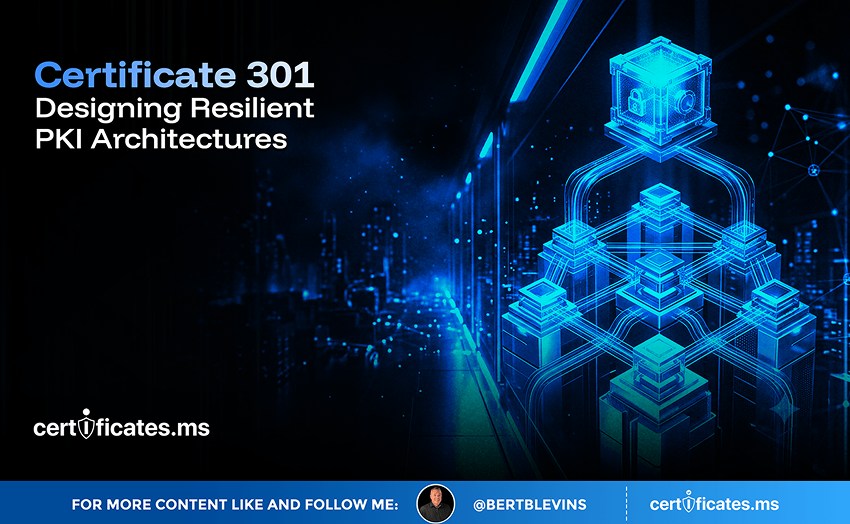
Certificate 301: Designing Resilient PKI Architectures
A PKI can be architecturally sophisticated, well-governed, and fully automated, and still fail catastrophically the moment a single issuing CA goes down or a data center becomes unreachable. Resilience is a distinct design concern from the structural and automation topics covered elsewhere in this series, focused specifically on what happens when something in the PKI itself breaks. This article covers how to design a PKI that survives failure rather than merely functioning correctly when everything is working.
Resilience Is a Different Question Than Structure
A well-designed CA hierarchy, covered in the earlier advanced PKI design article in this series, answers questions about scope, segmentation, and policy. Resilience asks a different question entirely: if this specific issuing CA becomes unavailable right now, what actually happens to every service depending on it for renewal? A PKI can have an excellent hierarchy and still be a single point of failure in practice, if that hierarchy was never explicitly designed with redundancy and failover in mind.
High Availability for Issuing CAs
Issuing CAs, the component that handles day-to-day certificate requests, should run in redundant, load-balanced configurations rather than as a single instance, with automatic failover tested regularly rather than assumed to work correctly if it has never actually been triggered outside of a real emergency. Given how much automated renewal now depends on an issuing CA responding reliably, an issuing CA outage in a fully automated environment can silently block every renewal attempt during the outage window, potentially causing a wave of expirations shortly afterward if the outage lasts long enough.
Geographic Redundancy and Disaster Recovery
Organizations with meaningful geographic distribution should consider running issuing CA infrastructure across multiple regions or data centers, so a regional outage does not halt certificate issuance for the entire organization. This requires careful planning around key synchronization and data consistency across regions, since an issuing CA’s operational database, tracking issued certificates and serial numbers, needs to remain consistent to avoid serial number collisions or gaps in the issuance audit trail during a failover event.
Root CA Availability Is a Different Problem Entirely
Root CAs are deliberately kept offline and rarely accessed, discussed elsewhere in this series, which means their resilience concern is fundamentally different from an issuing CA’s: the risk is not day-to-day availability, since the root is not meant to be online day to day, but ensuring the root key and its backup can actually be recovered and brought online safely when genuinely needed, such as signing a new intermediate. Well-designed root CA resilience includes securely stored, geographically separated backups of the root key material, with a clearly documented and periodically tested recovery procedure, rather than assuming a single copy of the root key in a single secure location is sufficient protection against every plausible disaster scenario.
Designing Automated Renewal to Tolerate Partial Failures
Resilient automation should be designed to degrade gracefully rather than fail catastrophically when part of the pipeline experiences an issue, for instance retrying failed renewal attempts with appropriate backoff rather than simply failing silently once, and routing critical alerts to a genuinely monitored channel rather than one that could itself be affected by the same underlying outage causing the renewal failure in the first place. Building in redundant alerting paths, so a monitoring system outage does not also silence the alert that would have flagged it, is a subtle but important resilience consideration many otherwise well-automated pipelines overlook.
Testing Resilience Deliberately Rather Than Discovering Gaps During a Real Incident
The only reliable way to know whether a PKI’s resilience design actually works is to test it deliberately, through planned failover exercises, simulated regional outages, and periodic root key recovery drills, rather than waiting to discover gaps during an actual crisis when the stakes are considerably higher. Organizations that treat these exercises as a routine, scheduled practice rather than a one-time setup task tend to catch resilience gaps, outdated runbooks, missing access permissions, forgotten dependencies, well before those gaps matter in a genuine emergency.
Resilience Considerations for AI-Dependent Certificate Infrastructure
As AI-driven infrastructure increasingly depends on rapid, continuous certificate issuance for ephemeral workloads, discussed throughout this series, PKI resilience becomes directly tied to AI system availability in a way it was not when certificates changed only a few times a year. An issuing CA outage that would have been a minor inconvenience under an annual renewal model can directly disrupt AI-driven services provisioning new short-lived identities continuously, making resilient PKI design a genuine dependency for AI infrastructure reliability, not merely a traditional IT operations concern.
The Countdown Is Already Running: 200 Days, 100 Days, 47 Days
Every certificate conversation in 2026 eventually arrives at the same clock, and it is worth closing on it here. The CA/Browser Forum’s Ballot SC-081v3 is not a proposal under discussion; it is an approved, already-in-motion schedule. Maximum public TLS certificate lifetimes fall from 398 days to 200 days on March 15, 2026. They fall again to 100 days on March 15, 2027. By March 15, 2029, they drop to just 47 days, with domain validation itself needing to be re-proven roughly every 10 days.
Translate that into operational terms and the picture gets stark quickly. An organization currently renewing certificates a few times a year will be handling renewal events on the order of every couple of weeks by the end of this countdown, across every endpoint it operates. Manual tracking, calendar reminders, and a spreadsheet somebody checks once a month will not survive contact with that cadence. What has always been an occasional chore is becoming a continuous, automated operation, whether an organization plans for it or not.
Resilience matters more, not less, as the schedule below compresses maximum certificate lifetimes toward 47 days, since a PKI issuing outage under that cadence has far less slack to recover before certificates genuinely start expiring, making the failover and redundancy design discussed throughout this article an operational necessity rather than an optional hardening step.
The 200-day, 100-day, and 47-day milestones are not distant hypotheticals; the first has already arrived. Organizations that build the automation loop now, generating keys, vaulting them securely, brokering issuance across Certificate Authorities through APIs, and rebinding certificates to live endpoints without manual intervention, will meet each deadline without disruption. Organizations that wait will be rebuilding their certificate operations under deadline pressure, with far less room for error and far less time to get it right. The countdown is the call to action. The only real decision left is whether to automate on your own schedule, or on the CA/Browser Forum’s.