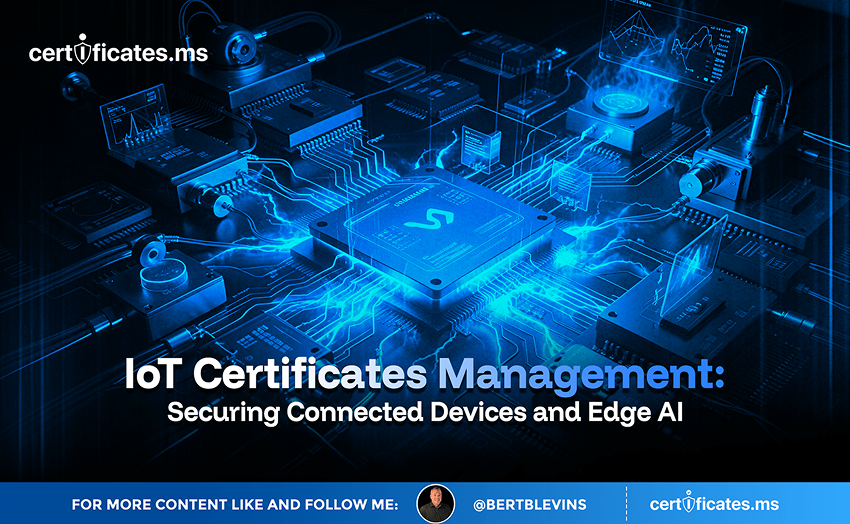
IoT Certificate Management: Securing Connected Devices and Edge AI
Internet of Things devices present one of the hardest certificate management problems in the entire PKI world. They are numerous, often constrained in computing power, frequently deployed in places nobody can walk up to and log into, and expected to stay in the field for years, sometimes decades. This article covers what makes IoT certificate management distinct from traditional enterprise PKI, and what it takes to get right.
Why IoT Breaks the Standard Certificate Playbook
Traditional certificate management assumes a few things: someone can log into the device to install a renewed certificate, the device has reliable network connectivity, and there is enough compute available to handle standard TLS operations comfortably. IoT devices routinely violate all three assumptions. A sensor deployed in a remote agricultural field or embedded in industrial equipment may have intermittent connectivity, limited processing power, and no administrative interface a technician can casually access once installed. Any certificate strategy built around manual intervention simply does not survive contact with a fleet of thousands of devices distributed across inaccessible locations.
Provisioning Identity at Manufacture
The strongest IoT certificate strategies start identity provisioning during manufacturing, not after deployment. Each device is issued a unique certificate, often tied to a hardware root of trust such as a Trusted Platform Module or secure element, before it ever leaves the factory. This gives every device a cryptographically verifiable identity from day one, rather than relying on shared credentials or default passwords that are far easier to compromise at scale and notoriously difficult to fully eliminate once devices are already in the field.
Automated Enrollment Protocols
Protocols such as EST, the Enrollment over Secure Transport, and SCEP, the Simple Certificate Enrollment Protocol, exist specifically to let constrained devices request and renew certificates programmatically, without a human involved. Newer deployments increasingly favor lightweight ACME-based clients adapted for constrained environments, along with over-the-air update mechanisms that push renewed certificates to devices automatically. These protocols matter because they are frequently the only realistic path to renewing certificates on a device that is physically unreachable.
Handling Intermittent Connectivity
A device that only connects to the network occasionally cannot rely on the same renewal cadence as an always-on server. IoT certificate strategies typically build in longer renewal windows relative to certificate lifetime, so a device has multiple opportunities to check in and renew before its current certificate actually expires, along with fallback behavior for devices that miss their renewal window entirely, ranging from degraded operation to a defined re-enrollment process rather than a hard failure that takes the device permanently offline.
Revocation at Scale
Revoking a certificate for a compromised IoT device is more complicated than revoking one for a server, because the device itself may need to learn about its own revocation, or downstream systems need a reliable way to check revocation status for devices that rarely phone home. Well-designed IoT PKI systems build revocation checking into the device’s normal communication pattern rather than treating it as a separate process, and maintain clear procedures for physically decommissioning devices whose certificates cannot be reliably revoked remotely.
Edge AI Raises the Stakes
A growing share of IoT deployments now run AI models directly on the device, processing sensor data locally rather than sending everything to the cloud. These edge AI devices frequently make autonomous decisions, adjusting equipment, flagging anomalies, or triggering downstream actions, based on what they infer locally. That autonomy makes the device’s identity more consequential than a simple sensor’s: a compromised edge AI device is not just leaking data, it may be actively feeding false inferences or unauthorized commands into a system that trusts it. Certificate-based identity is what allows the rest of the environment to distinguish a legitimate edge AI device from an impersonator, making rigorous IoT certificate management arguably more important for AI-enabled devices than for the simpler sensors IoT security discussions have traditionally focused on.
Building a Realistic IoT Certificate Strategy
Organizations deploying IoT fleets should treat certificate management as a first-class part of the device lifecycle, starting at manufacture and continuing through eventual decommissioning, not as an afterthought bolted on once devices are already in the field. That means choosing hardware with a genuine root of trust, selecting enrollment protocols suited to constrained and intermittently connected environments, and building revocation and monitoring processes that assume devices cannot always be reached directly.
The Countdown Is Already Running: 200 Days, 100 Days, 47 Days
Every certificate conversation in 2026 eventually arrives at the same clock, and it is worth closing on it here. The CA/Browser Forum’s Ballot SC-081v3 is not a proposal under discussion; it is an approved, already-in-motion schedule. Maximum public TLS certificate lifetimes fall from 398 days to 200 days on March 15, 2026. They fall again to 100 days on March 15, 2027. By March 15, 2029, they drop to just 47 days, with domain validation itself needing to be re-proven roughly every 10 days.
Translate that into operational terms and the picture gets stark quickly. An organization currently renewing certificates a few times a year will be handling renewal events on the order of every couple of weeks by the end of this countdown, across every endpoint it operates. Manual tracking, calendar reminders, and a spreadsheet somebody checks once a month will not survive contact with that cadence. What has always been an occasional chore is becoming a continuous, automated operation, whether an organization plans for it or not.
IoT devices issued certificates from public CAs are subject to the same shrinking lifetime schedule as every other public certificate, which makes automated, unattended renewal even more critical for fleets that cannot practically be updated by hand as validity windows shrink toward 47 days.
The 200-day, 100-day, and 47-day milestones are not distant hypotheticals; the first has already arrived. Organizations that build the automation loop now, generating keys, vaulting them securely, brokering issuance across Certificate Authorities through APIs, and rebinding certificates to live endpoints without manual intervention, will meet each deadline without disruption. Organizations that wait will be rebuilding their certificate operations under deadline pressure, with far less room for error and far less time to get it right. The countdown is the call to action. The only real decision left is whether to automate on your own schedule, or on the CA/Browser Forum’s.