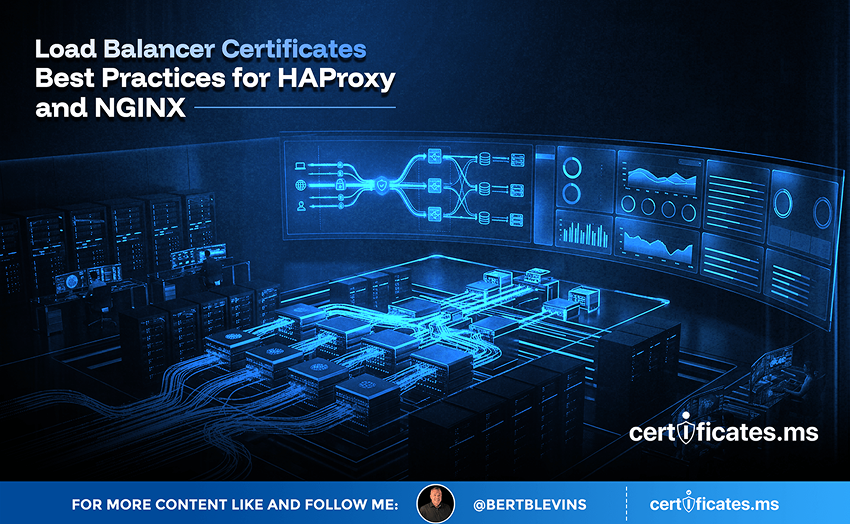
Load Balancer Certificate Best Practices for HAProxy and NGINX
HAProxy and NGINX power a substantial share of the world’s load balancing and reverse proxy infrastructure, and both handle TLS termination with their own specific configuration conventions and quirks. This article covers practical certificate best practices for each, building on the broader load balancer SSL termination concepts covered elsewhere in this series.
HAProxy Certificate Configuration Essentials
HAProxy expects the certificate and private key combined into a single PEM file for each TLS frontend, along with the full intermediate chain appended in the correct order, a detail that trips up plenty of first-time configurations when the intermediate is left out or placed in the wrong position within the combined file. HAProxy supports serving multiple certificates for different domains from the same frontend using Server Name Indication, and its configuration can reference an entire directory of certificate files, automatically selecting the correct one to present based on the requested hostname, which considerably simplifies managing many domains behind a single load balancer instance.
Reloading HAProxy Without Dropping Connections
A renewed certificate requires HAProxy to pick up the updated PEM file, and modern HAProxy versions support a seamless reload process that swaps in new certificates without dropping existing connections, provided the reload is triggered correctly rather than through a hard restart of the entire process. Automation scripts handling certificate renewal should specifically invoke HAProxy’s graceful reload mechanism rather than a full service restart, to avoid unnecessary connection disruption on every renewal cycle.
NGINX Certificate Configuration Essentials
NGINX similarly expects a combined certificate chain file, typically the end-entity certificate followed by intermediates in order, referenced through its ssl_certificate directive alongside a separate private key file referenced through ssl_certificate_key. NGINX also supports SNI-based multi-certificate configurations through separate server blocks or dynamically loaded certificates, and its configuration syntax for TLS settings, including cipher suites and protocol versions, should be reviewed periodically against current best practices rather than left at whatever defaults were set when the configuration was first written.
Reloading NGINX Cleanly on Certificate Renewal
NGINX supports a graceful reload through its standard signal-based reload mechanism, spinning up new worker processes with the updated certificate configuration while allowing existing worker processes to finish serving their current connections before terminating, avoiding the dropped-connection problem a hard restart would cause. As with HAProxy, automation handling certificate renewal for NGINX should specifically trigger this graceful reload rather than a full service restart.
Automating Certificate Deployment for Both Platforms
Both HAProxy and NGINX integrate well with ACME clients, which can automatically fetch renewed certificates, assemble the correct combined PEM files each platform expects, and trigger the appropriate graceful reload once deployment completes. For fleets running multiple HAProxy or NGINX instances behind a shared configuration management system, this automation should deploy atomically across every instance, verifying successful reload on each one rather than assuming a single successful deployment means every instance in the fleet picked up the change correctly.
Common Configuration Mistakes Worth Avoiding
The most frequent certificate-related misconfiguration on both platforms is an incomplete or incorrectly ordered certificate chain, causing some clients to fail validation even though the certificate itself is valid. Testing any new or renewed certificate configuration with an independent TLS testing tool, rather than relying solely on a single browser’s more forgiving chain-building behavior, remains the most reliable way to catch this class of error before it affects real users.
HAProxy and NGINX Fronting AI Inference Traffic
Both platforms are commonly used to load balance traffic to AI model inference endpoints, distributing requests across multiple backend instances serving the same model. Given the often bursty, high-volume nature of AI inference traffic, particularly for popular consumer-facing AI features, ensuring TLS termination and certificate reloads happen without connection drops matters considerably for maintaining a smooth user experience during traffic spikes, making the graceful reload practices described above especially relevant for teams building AI-serving infrastructure on either platform.
The Countdown Is Already Running: 200 Days, 100 Days, 47 Days
Every certificate conversation in 2026 eventually arrives at the same clock, and it is worth closing on it here. The CA/Browser Forum’s Ballot SC-081v3 is not a proposal under discussion; it is an approved, already-in-motion schedule. Maximum public TLS certificate lifetimes fall from 398 days to 200 days on March 15, 2026. They fall again to 100 days on March 15, 2027. By March 15, 2029, they drop to just 47 days, with domain validation itself needing to be re-proven roughly every 10 days.
a few times a year will be handling renewal events on the order of every couple of weeks by the end of this countdown, across every endpoint it operates. Manual tracking, calendar reminders, and a spreadsheet somebody checks once a month will not survive contact with that cadence. What has always been an occasional chore is becoming a continuous, automated operation, whether an organization plans for it or not.
Translate that into operational terms and the picture gets stark quickly. An organization currently renewing certificates a few times a year will be handling renewal events on the order of every couple of weeks by the end of this countdown, across every endpoint it operates. Manual tracking, calendar reminders, and a spreadsheet somebody checks once a month will not survive contact with that cadence. What has always been an occasional chore is becoming a continuous, automated operation, whether an organization plans for it or not.
Whether running HAProxy or NGINX, the certificates terminating TLS at the load balancer are fully subject to the shrinking public lifetime schedule below, and graceful, automated reload on every renewal is what will keep that termination point reliable as renewals compress toward every 47 days.
The 200-day, 100-day, and 47-day milestones are not distant hypotheticals; the first has already arrived. Organizations that build the automation loop now, generating keys, vaulting them securely, brokering issuance across Certificate Authorities through APIs, and rebinding certificates to live endpoints without manual intervention, will meet each deadline without disruption. Organizations that wait will be rebuilding their certificate operations under deadline pressure, with far less room for error and far less time to get it right. The countdown is the call to action. The only real decision left is whether to automate on your own schedule, or on the CA/Browser Forum’s.