IoT Certificate Rotation Strategies Without Downtime
Rotating a certificate on a server sitting in a data center is one thing; rotating a certificate on a device deployed in a customer’s home, a remote industrial site, or embedded inside a piece of equipment that cannot simply be taken offline is an entirely different operational challenge. This article focuses specifically on rotating IoT device certificates without disrupting the device’s ongoing operation, building on the broader IoT certificate management concepts covered earlier in this series.
Why Downtime During Rotation Is Especially Costly for IoT
A brief service interruption during certificate rotation on a web server is generally an acceptable, barely noticed inconvenience. The same brief interruption on an IoT device controlling physical equipment, monitoring critical infrastructure, or supporting a customer’s in-home smart device experience can mean lost sensor readings during a critical monitoring window, a visible service disruption a customer directly notices, or in industrial contexts, a genuinely costly operational interruption. This raises the bar considerably for how carefully IoT certificate rotation needs to be engineered.
The Overlap Window Strategy
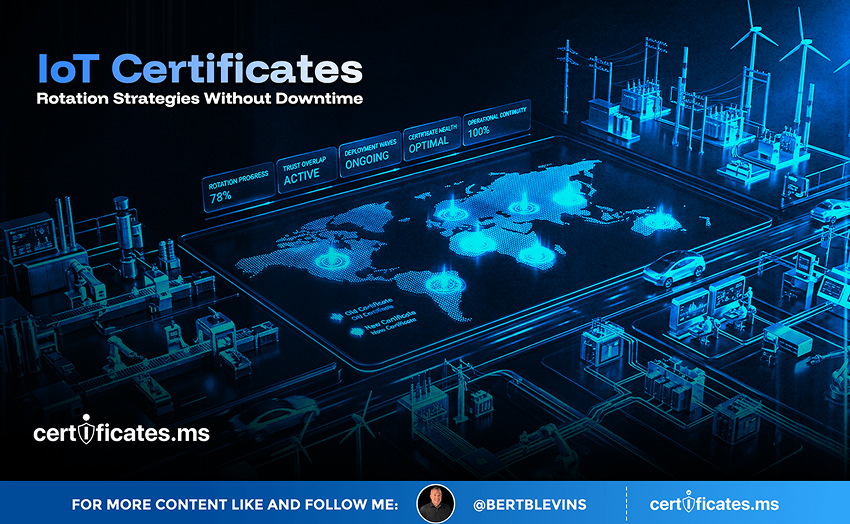
The most reliable approach to zero-downtime rotation maintains both the old and new certificates as simultaneously valid for a defined overlap window, allowing a device to switch to presenting the new certificate gradually rather than requiring an instantaneous, all-at-once cutover across an entire fleet. During this overlap period, both certificates remain trusted by relying systems, giving devices with intermittent connectivity or slower update propagation time to pick up the new certificate without any period where they present an already-invalid one.
Dual-Certificate Support on the Device Itself
Well-designed IoT firmware supports holding two valid certificates simultaneously during a rotation window, attempting authentication with the newer certificate first and falling back to the still-valid older one if the new certificate has not yet been successfully installed for any reason. This dual-support pattern, combined with the overlap window described above, allows rotation to happen gradually and safely across a large, heterogeneous fleet without requiring every device to update in perfect synchronization.
Staged Rollout Rather Than Fleet-Wide Simultaneous Rotation
Rotating an entire device fleet’s certificates simultaneously concentrates risk considerably: if something goes wrong with the new certificate or the rotation process itself, every device in the fleet is affected at once. A staged rollout, rotating a small percentage of the fleet first, verifying successful rotation and continued normal operation, then progressively expanding to larger segments of the fleet, catches problems early on a limited subset of devices rather than discovering an issue only after it has already affected the entire deployed population.
Handling Devices That Miss the Rotation Window
Some devices will inevitably be offline, in a degraded connectivity state, or otherwise unreachable during a planned rotation window, and a robust strategy needs a defined fallback for these devices rather than simply losing track of them. This typically means devices that reconnect after an extended absence should automatically detect that their certificate needs rotation and trigger the process themselves upon reconnection, rather than requiring a separate, manual remediation process for every device that happened to miss the originally scheduled rotation window.
Testing Rotation Procedures Before Relying on Them at Scale
Given how costly a failed rotation can be for IoT deployments specifically, rotation procedures should be tested thoroughly against a representative subset of real device hardware and firmware versions before being trusted against a full production fleet, since IoT device populations often include multiple hardware generations and firmware versions that may behave subtly differently during a rotation process than a single, controlled test environment would reveal.
Rotation Strategies for Edge AI Device Fleets
Edge AI devices, discussed elsewhere in this series, generally warrant the same careful, staged rotation approach as any other IoT device, with additional attention to ensuring the device’s onboard AI model or inference pipeline continues functioning correctly throughout the rotation window, since an interruption affecting an edge AI device’s network identity could also disrupt whatever automated decision-making or reporting that device is actively performing at the moment rotation occurs.
The Countdown Is Already Running: 200 Days, 100 Days, 47 Days
Every certificate conversation in 2026 eventually arrives at the same clock, and it is worth closing on it here. The CA/Browser Forum’s Ballot SC-081v3 is not a proposal under discussion; it is an approved, already-in-motion schedule. Maximum public TLS certificate lifetimes fall from 398 days to 200 days on March 15, 2026. They fall again to 100 days on March 15, 2027. By March 15, 2029, they drop to just 47 days, with domain validation itself needing to be re-proven roughly every 10 days.
Translate that into operational terms and the picture gets stark quickly. An organization currently renewing certificates a few times a year will be handling renewal events on the order of every couple of weeks by the end of this countdown, across every endpoint it operates. Manual tracking, calendar reminders, and a spreadsheet somebody checks once a month will not survive contact with that cadence. What has always been an occasional chore is becoming a continuous, automated operation, whether an organization plans for it or not.
As the schedule below compresses maximum public certificate lifetimes toward 47 days, IoT fleets issued certificates from public CAs will need to execute the zero-downtime rotation strategies described above far more frequently than today, making a well-tested, automated rotation process an operational necessity rather than a periodic engineering project.
The 200-day, 100-day, and 47-day milestones are not distant hypotheticals; the first has already arrived. Organizations that build the automation loop now, generating keys, vaulting them securely, brokering issuance across Certificate Authorities through APIs, and rebinding certificates to live endpoints without manual intervention, will meet each deadline without disruption. Organizations that wait will be rebuilding their certificate operations under deadline pressure, with far less room for error and far less time to get it right. The countdown is the call to action. The only real decision left is whether to automate on your own schedule, or on the CA/Browser Forum’s.