Cost-Benefit Analysis: In-House CA vs Managed PKI Services
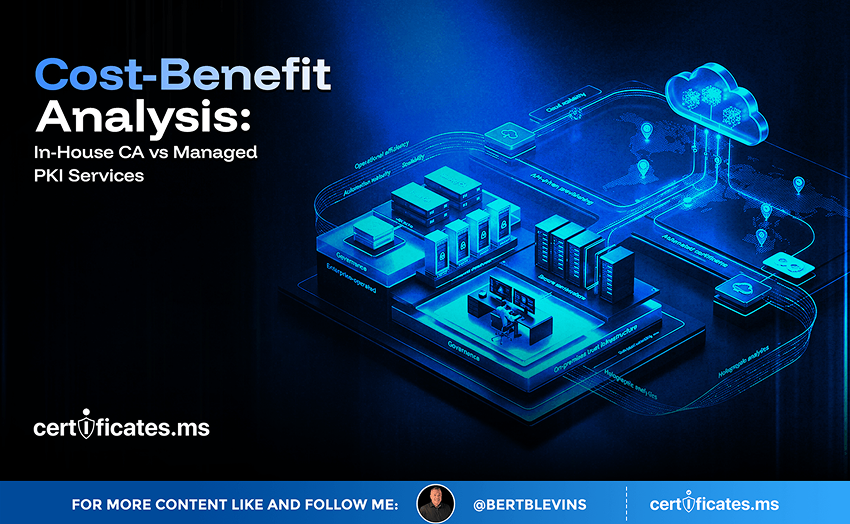
Deciding whether to build and run a private CA internally or adopt a managed PKI service is one of the more consequential infrastructure decisions a growing organization will make, and it deserves a genuine cost-benefit comparison rather than a default assumption in either direction. This article walks through that comparison directly.
What Running an In-House CA Actually Costs
Building and operating a private CA internally, following the design patterns discussed elsewhere in this series, requires upfront investment in software or hardware, potentially including a hardware security module for root key protection, along with ongoing engineering time for maintenance, monitoring, and responding to any operational issues. It also requires developing genuine internal expertise, since PKI operation involves specialized knowledge that takes time to build and retain, and staff turnover in a small internal PKI team can create real continuity risk if institutional knowledge is not well documented.
What Managed PKI Services Actually Cost
Managed PKI services, offered by many of the CAs discussed earlier in this series alongside dedicated PKI-as-a-service providers, shift much of the operational burden to the vendor in exchange for ongoing subscription or usage-based fees. This model reduces the internal expertise requirement considerably, since the vendor handles the underlying CA operation, security, and much of the compliance burden, but it introduces a degree of dependency on the vendor’s reliability, pricing stability, and continued support for the organization’s specific use case.
Where In-House Ownership Tends to Win
Organizations with very high certificate volume, specific and unusual policy requirements that a managed service’s standard offering does not accommodate well, or strict regulatory or data sovereignty requirements mandating that key material never leave organizationally controlled infrastructure, often find the total cost of an in-house CA justified despite the higher upfront investment. Organizations with the existing engineering capacity and PKI expertise to operate this infrastructure well also tend to find in-house ownership more cost-effective at sufficient scale, since managed service costs typically scale with usage in a way that can eventually exceed the amortized cost of internal infrastructure.
Where Managed Services Tend to Win
Organizations without existing deep PKI expertise, or those prioritizing faster time to a working, secure PKI over long-term cost optimization, generally find managed services the more practical choice, since the vendor’s existing expertise and infrastructure eliminate much of the ramp-up time and risk associated with building internal PKI capability from scratch. Smaller organizations, or those whose certificate needs, while real, do not justify dedicating specialized internal staff to PKI operation, are also typically better served by a managed service’s economies of scale.
The Hybrid Middle Ground
Many organizations land on a hybrid approach, using a managed service for the bulk of their certificate needs while retaining tighter internal control, sometimes through an in-house root with a managed intermediate, or vice versa, for the smaller set of certificates with genuinely specific requirements a standard managed offering cannot accommodate. This hybrid model can capture much of the operational simplicity of a managed service while preserving the control an organization genuinely needs for its most sensitive certificate categories.
Building an Honest Comparison Model
A genuine cost-benefit analysis should account for the full cost of each option over a multi-year horizon, not just the immediate implementation cost, explicitly factoring in the shrinking certificate lifetime schedule discussed throughout this series, since both options’ costs will be affected by rising renewal frequency, though potentially in different ways depending on whether a managed service’s pricing model scales with issuance volume. Organizations should also weigh the harder-to-quantify factors: how much internal expertise the organization genuinely wants to build and retain, and how comfortable the organization is with the specific vendor dependency a managed service introduces.
This Decision for AI-Heavy Infrastructure Specifically
Organizations with significant and rapidly growing AI infrastructure certificate needs should weigh this decision partly around which option better supports the high-volume, API-driven, short-lived issuance patterns AI and machine identities require, discussed throughout this series, since a managed service or in-house CA that was not designed with this kind of scale and velocity in mind can become a bottleneck as AI-driven certificate demand grows faster than either option’s original planning assumptions anticipated.
The Countdown Is Already Running: 200 Days, 100 Days, 47 Days
Every certificate conversation in 2026 eventually arrives at the same clock, and it is worth closing on it here. The CA/Browser Forum’s Ballot SC-081v3 is not a proposal under discussion; it is an approved, already-in-motion schedule. Maximum public TLS certificate lifetimes fall from 398 days to 200 days on March 15, 2026. They fall again to 100 days on March 15, 2027. By March 15, 2029, they drop to just 47 days, with domain validation itself needing to be re-proven roughly every 10 days.
Translate that into operational terms and the picture gets stark quickly. An organization currently renewing certificates a few times a year will be handling renewal events on the order of every couple of weeks by the end of this countdown, across every endpoint it operates. Manual tracking, calendar reminders, and a spreadsheet somebody checks once a month will not survive contact with that cadence. What has always been an occasional chore is becoming a continuous, automated operation, whether an organization plans for it or not.
Whichever option an organization chooses, its ability to support fully automated issuance at the pace the schedule below requires should be a central factor in the decision, since both in-house and managed PKI need to keep pace with renewals every 47 days, and neither choice is a substitute for that underlying automation requirement.
The 200-day, 100-day, and 47-day milestones are not distant hypotheticals; the first has already arrived. Organizations that build the automation loop now, generating keys, vaulting them securely, brokering issuance across Certificate Authorities through APIs, and rebinding certificates to live endpoints without manual intervention, will meet each deadline without disruption. Organizations that wait will be rebuilding their certificate operations under deadline pressure, with far less room for error and far less time to get it right. The countdown is the call to action. The only real decision left is whether to automate on your own schedule, or on the CA/Browser Forum’s.