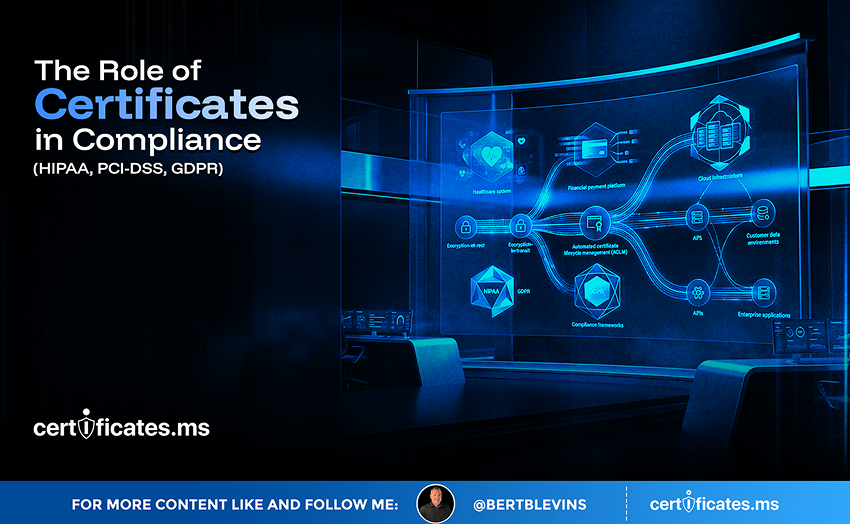
The Role of Certificates in Compliance (HIPAA, PCI-DSS, GDPR)
Certificates rarely get mentioned by name in the headline requirements of major regulatory frameworks, but they are quietly load-bearing infrastructure underneath a significant share of what these frameworks actually require in practice. This article covers how certificates support compliance obligations under HIPAA, PCI-DSS, and GDPR specifically, and what auditors under each framework tend to actually scrutinize.
HIPAA: Protecting Data in Transit
HIPAA’s Security Rule requires covered entities to implement technical safeguards protecting the confidentiality and integrity of electronic protected health information, and while the regulation itself does not mandate a specific encryption technology by name, TLS backed by properly managed certificates has become the de facto standard mechanism for satisfying the transmission security requirement wherever protected health information moves across a network. Auditors reviewing HIPAA compliance commonly examine whether TLS is properly configured and enforced everywhere protected health information travels, and whether the organization has a documented process for managing the certificates underlying that encryption, not simply whether encryption exists somewhere in the architecture.
PCI-DSS: Explicit Certificate and Key Management Requirements
PCI-DSS is considerably more explicit than HIPAA about certificate and cryptographic key management specifically, with detailed requirements covering strong cryptography for cardholder data transmission, documented key management processes, and restrictions on outdated TLS versions and weak cipher suites. Organizations handling payment card data should expect PCI-DSS assessors to directly examine certificate validity periods, key storage practices, and whether expired or weak configurations exist anywhere within the cardholder data environment, making certificate hygiene a direct, explicit line item in PCI compliance rather than an implicit supporting concern.
GDPR: Certificates as Part of Appropriate Technical Measures
GDPR requires organizations to implement appropriate technical and organizational measures to protect personal data, a deliberately broad standard that data protection authorities and courts have interpreted to include encryption of data in transit as an expected baseline practice for any organization processing meaningful volumes of personal data. While GDPR does not specify certificate management practices in the granular detail PCI-DSS does, a data breach involving personal data transmitted without proper encryption, traceable to a lapsed or misconfigured certificate, can become a significant factor in both the severity of any resulting penalty and the broader narrative of whether the organization took data protection seriously.
The Common Thread Across All Three Frameworks
Despite their different specific requirements, all three frameworks ultimately expect the same underlying operational discipline: encryption properly implemented and consistently maintained, not merely present at some point during initial deployment, and a documented, demonstrable process for managing the certificates and keys that make that encryption meaningful. Auditors across all three frameworks increasingly ask not just whether encryption exists, but whether the organization can produce evidence of ongoing certificate management, inventory records, renewal logs, and revocation procedures, rather than accepting a one-time architecture review as sufficient proof of continued compliance.
Why Audit Evidence Requires More Than a Working Configuration
A common compliance gap involves organizations having genuinely well-configured TLS and certificate practices in production, but lacking the documentation and audit trail needed to actually demonstrate that to an assessor, since compliance frameworks increasingly expect evidence of process, not just evidence of current technical state. Organizations should maintain clear records of certificate issuance policies, renewal automation configuration, and revocation procedures specifically with an eye toward what an auditor would need to see, rather than assuming a technically sound configuration alone will satisfy a compliance review.
Compliance Implications of the Shrinking Certificate Lifetime Schedule
The CA/Browser Forum’s schedule reducing maximum certificate lifetimes has an indirect but real compliance dimension: organizations relying on manual certificate management processes are more likely to experience a lapse as renewal frequency increases, and any resulting outage or misconfiguration affecting regulated data flows becomes both a compliance and a security incident simultaneously. Building automated, well-documented certificate management now positions an organization considerably better for compliance audits under all three frameworks discussed here, regardless of which specific framework applies to a given organization’s data.
Certificates Supporting Compliance for AI Systems Processing Regulated Data
AI systems processing health information, payment data, or personal data subject to GDPR inherit the same certificate-related compliance obligations as any other system handling that category of data, and organizations deploying AI features touching regulated data should apply the same certificate management rigor, and the same documentation discipline, to the AI system’s data transmission paths as they would to any other regulated system, rather than treating AI infrastructure as somehow exempt from these established compliance expectations.
The Countdown Is Already Running: 200 Days, 100 Days, 47 Days
Every certificate conversation in 2026 eventually arrives at the same clock, and it is worth closing on it here. The CA/Browser Forum’s Ballot SC-081v3 is not a proposal under discussion; it is an approved, already-in-motion schedule. Maximum public TLS certificate lifetimes fall from 398 days to 200 days on March 15, 2026. They fall again to 100 days on March 15, 2027. By March 15, 2029, they drop to just 47 days, with domain validation itself needing to be re-proven roughly every 10 days.
Translate that into operational terms and the picture gets stark quickly. An organization currently renewing certificates a few times a year will be handling renewal events on the order of every couple of weeks by the end of this countdown, across every endpoint it operates. Manual tracking, calendar reminders, and a spreadsheet somebody checks once a month will not survive contact with that cadence. What has always been an occasional chore is becoming a continuous, automated operation, whether an organization plans for it or not.
Compliance documentation and audit evidence will need to reflect the shrinking public certificate lifetime schedule below as it takes effect, since auditors reviewing certificate management practices under any of these frameworks will increasingly expect to see automation capable of handling renewals every 47 days, not processes still designed around annual or multi-year cycles.
The 200-day, 100-day, and 47-day milestones are not distant hypotheticals; the first has already arrived. Organizations that build the automation loop now, generating keys, vaulting them securely, brokering issuance across Certificate Authorities through APIs, and rebinding certificates to live endpoints without manual intervention, will meet each deadline without disruption. Organizations that wait will be rebuilding their certificate operations under deadline pressure, with far less room for error and far less time to get it right. The countdown is the call to action. The only real decision left is whether to automate on your own schedule, or on the CA/Browser Forum’s.