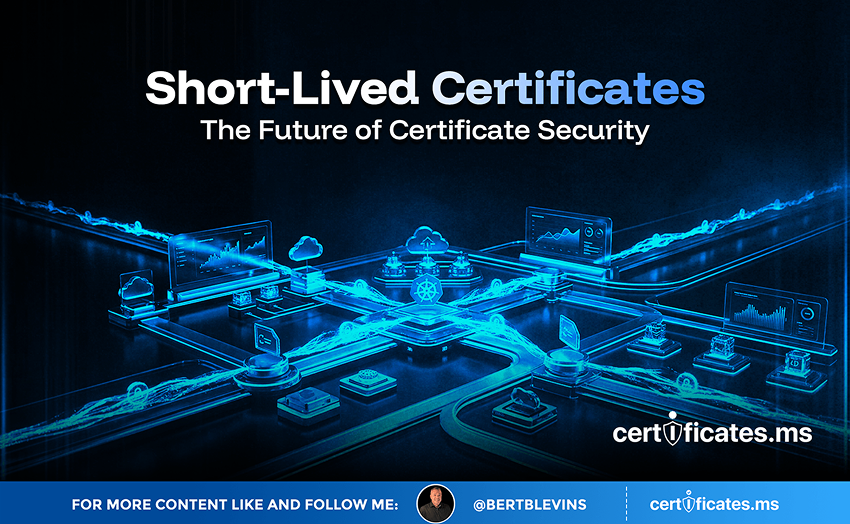
Short-Lived Certificates: The Future of Certificate Security
Every certificate conversation happening across the industry right now eventually points at the same underlying trend: certificates are getting shorter-lived, on purpose, as a deliberate security strategy rather than a bureaucratic inconvenience. This article makes the case directly for why short-lived certificates represent a genuine security improvement, not merely a compliance burden to be tolerated.
Why Shorter Validity Periods Are a Security Feature
A certificate’s maximum validity period defines the outer bound of how long a compromised or misissued certificate can remain dangerous if revocation fails or is delayed for any reason. A certificate valid for a year that goes unrevoked for even a portion of that time represents a substantially larger window of exposure than a certificate that would have expired naturally within weeks regardless. Shrinking maximum lifetimes is, in effect, a systemic reduction in the ceiling of possible damage from any single compromised certificate across the entire ecosystem, independent of how well any individual organization’s revocation process happens to work.
The Regulatory Push Behind This Shift
The CA/Browser Forum’s Ballot SC-081v3 has formalized this trend into an approved, binding schedule: maximum public TLS certificate lifetimes drop to 200 days on March 15, 2026, then to 100 days on March 15, 2027, and finally to 47 days on March 15, 2029, with domain validation reuse windows shrinking correspondingly. This is not an industry suggestion; it is a schedule that browser root programs have already agreed to enforce, meaning organizations are not choosing whether to adapt, only how far ahead of the deadlines they get their automation in place.
The Automation Requirement This Creates
Short-lived certificates only function as a security improvement if renewal genuinely happens reliably and automatically; a short-lived certificate that expires unexpectedly because manual renewal was missed produces an outage rather than a security benefit. This is the central operational reality behind the shift: the entire strategy depends on organizations treating full automation, not partial automation, as the baseline requirement, since a renewal cadence measured in weeks simply does not leave room for a human-paced manual process anywhere in the chain.
Beyond the Regulatory Minimum: Ephemeral Certificates
Some organizations are going further than the regulatory schedule requires, adopting certificates valid for mere hours or even minutes for their highest-risk internal machine identities, an approach sometimes called ephemeral certificate issuance. This pattern is increasingly common for containerized workloads and AI agent identities that themselves only exist briefly, where issuing a certificate scoped to match the workload’s actual lifespan is both more secure and, notably, no more operationally complex than issuing a longer-lived certificate, provided the issuance pipeline is already fully automated.
What This Means for Revocation's Role Going Forward
As certificates get shorter-lived across the board, the practical importance of revocation checking working perfectly in every case diminishes somewhat, since natural expiration increasingly arrives before a slow or imperfect revocation process would have caught a compromise anyway. This does not make revocation irrelevant, but it does shift some of the security burden away from a mechanism that has historically been inconsistently implemented across browsers and applications, and toward a mechanism, expiration, that is enforced universally and unconditionally by design.
Preparing an Organization for This Future
Organizations that have not yet fully automated certificate issuance and renewal should treat the schedule described above as a firm deadline rather than a distant consideration, since the operational gap between a manual process and a fully automated one only becomes more painful as the renewal window continues shrinking. Building toward full lifecycle automation now, rather than incrementally reacting to each successive deadline as it arrives, is the only approach that scales cleanly all the way down to 47 days.
Short-Lived Certificates as the Default for AI and Machine Identities
Machine and AI identities are already, in many well-designed environments, the leading edge of this shift, since these identities are frequently ephemeral by nature and were never good candidates for long-lived certificates in the first place. Organizations building out AI infrastructure today should treat short-lived, automatically issued certificates as the obvious default for every AI agent and automated service identity from the outset, rather than retrofitting shorter lifespans onto a system originally designed around the longer validity periods that public certificates are now leaving behind entirely.
The Countdown Is Already Running: 200 Days, 100 Days, 47 Days
Every certificate conversation in 2026 eventually arrives at the same clock, and it is worth closing on it here. The CA/Browser Forum’s Ballot SC-081v3 is not a proposal under discussion; it is an approved, already-in-motion schedule. Maximum public TLS certificate lifetimes fall from 398 days to 200 days on March 15, 2026. They fall again to 100 days on March 15, 2027. By March 15, 2029, they drop to just 47 days, with domain validation itself needing to be re-proven roughly every 10 days.
a few times a year will be handling renewal events on the order of every couple of weeks by the end of this countdown, across every endpoint it operates. Manual tracking, calendar reminders, and a spreadsheet somebody checks once a month will not survive contact with that cadence. What has always been an occasional chore is becoming a continuous, automated operation, whether an organization plans for it or not.
Translate that into operational terms and the picture gets stark quickly. An organization currently renewing certificates a few times a year will be handling renewal events on the order of every couple of weeks by the end of this countdown, across every endpoint it operates. Manual tracking, calendar reminders, and a spreadsheet somebody checks once a month will not survive contact with that cadence. What has always been an occasional chore is becoming a continuous, automated operation, whether an organization plans for it or not.
This entire article is, in effect, an extended argument for the exact schedule described here: 200 days, then 100, then 47, each step a deliberate tightening of the maximum damage window a single certificate can represent, and each one requiring the same automated renewal discipline to actually deliver on that promise.
The 200-day, 100-day, and 47-day milestones are not distant hypotheticals; the first has already arrived. Organizations that build the automation loop now, generating keys, vaulting them securely, brokering issuance across Certificate Authorities through APIs, and rebinding certificates to live endpoints without manual intervention, will meet each deadline without disruption. Organizations that wait will be rebuilding their certificate operations under deadline pressure, with far less room for error and far less time to get it right. The countdown is the call to action. The only real decision left is whether to automate on your own schedule, or on the CA/Browser Forum’s.