Mutual TLS (mTLS): Implementing Two-Way Certificate Auth
Mutual TLS has been referenced throughout this series as the mechanism underlying client certificate authentication, machine identity verification, and zero trust enforcement, but it deserves its own dedicated, practical treatment. This article walks through what mTLS actually involves at the implementation level and the considerations that separate a working mTLS deployment from a merely theoretical one.
Standard TLS vs Mutual TLS, Concretely
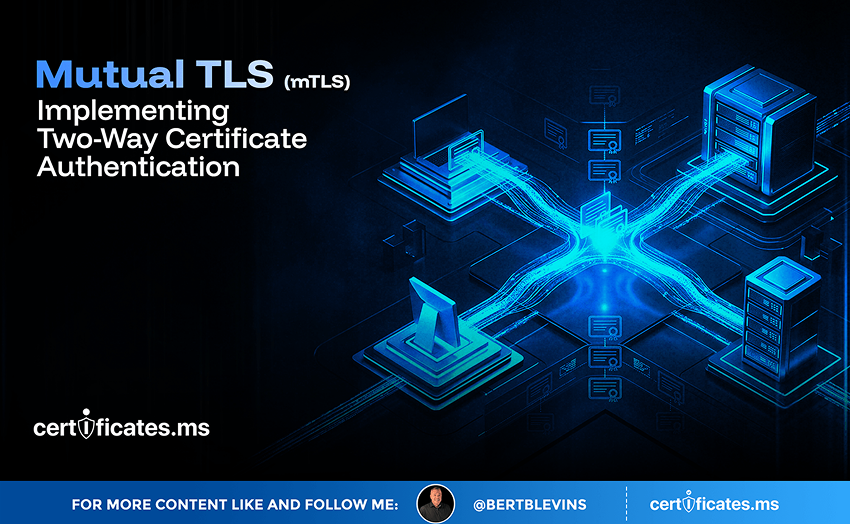
In standard TLS, only the server presents a certificate, and the client verifies it before establishing an encrypted connection; the server has no cryptographic proof of the client’s identity beyond whatever happens at the application layer afterward, such as a password submitted over the now-encrypted connection. Mutual TLS adds a second certificate exchange in the other direction: the client also presents a certificate during the handshake, and the server verifies it against its own trusted CA before the connection is considered fully authenticated, meaning both parties have cryptographically proven their identity before any application data is exchanged at all.
The Practical Handshake Sequence
An mTLS handshake extends the standard TLS handshake with an explicit client certificate request from the server and a corresponding certificate response from the client, verified against the server’s configured trusted CA or CAs before the handshake completes successfully. If the client fails to present a valid certificate, or presents one the server does not trust, the connection is rejected at the transport layer, before any application logic ever runs, which is a meaningfully stronger guarantee than rejecting an unauthorized request only after it has already reached application code.
Configuring Server-Side Trust for Client Certificates
Implementing mTLS requires the server to be configured with a trusted CA, typically an internal CA discussed elsewhere in this series, against which incoming client certificates are validated. This is a meaningfully different trust configuration than the standard server-side certificate setup, and it requires deliberate planning around which CA or CAs are trusted for client authentication specifically, since accepting client certificates from an overly broad set of trusted roots undermines the access control mTLS is meant to enforce.
Common Implementation Pitfalls
A frequent mTLS misconfiguration involves servers accidentally trusting a broader set of client certificate issuers than intended, effectively allowing any certificate from a widely trusted public root to authenticate, rather than restricting client trust specifically to the organization’s own internal CA meant to govern which clients are actually authorized. Another common issue involves inadequate error handling when a client certificate is missing or invalid, returning generic, unhelpful errors that make legitimate troubleshooting difficult, rather than clear, specific error messages distinguishing a missing certificate from an expired one or one issued by an untrusted CA.
mTLS at Scale: Service Mesh Integration
Manually configuring mTLS for every individual service in a microservice architecture does not scale well, which is why service mesh technologies, discussed briefly elsewhere in this series, have become the standard way to implement mTLS broadly across a large environment, automatically issuing, rotating, and enforcing certificate-based mutual authentication between every service in the mesh without requiring each individual development team to implement the underlying TLS configuration themselves.
Performance Considerations
mTLS adds a modest amount of computational overhead compared to standard TLS, given the additional certificate verification step, though this overhead is generally negligible relative to the security benefit for most workloads. Organizations running extremely high-throughput services should benchmark the actual performance impact in their specific environment rather than assuming it is negligible by default, particularly if certificate validation involves checking revocation status through a live query rather than a cached or stapled response.
mTLS Between AI Agents and Internal Services
mTLS is an increasingly standard pattern for authenticating AI agents calling internal services, giving both the agent and the service cryptographic proof of each other’s identity before any request is processed, rather than relying on a simple bearer token that could be replayed if intercepted. Organizations building internal AI agent infrastructure should treat mTLS as the default authentication model for agent-to-service communication wherever the underlying infrastructure supports it, extending the same zero trust discipline discussed elsewhere in this series to the agent’s own network calls.
The Countdown Is Already Running: 200 Days, 100 Days, 47 Days
Every certificate conversation in 2026 eventually arrives at the same clock, and it is worth closing on it here. The CA/Browser Forum’s Ballot SC-081v3 is not a proposal under discussion; it is an approved, already-in-motion schedule. Maximum public TLS certificate lifetimes fall from 398 days to 200 days on March 15, 2026. They fall again to 100 days on March 15, 2027. By March 15, 2029, they drop to just 47 days, with domain validation itself needing to be re-proven roughly every 10 days.
Translate that into operational terms and the picture gets stark quickly. An organization currently renewing certificates a few times a year will be handling renewal events on the order of every couple of weeks by the end of this countdown, across every endpoint it operates. Manual tracking, calendar reminders, and a spreadsheet somebody checks once a month will not survive contact with that cadence. What has always been an occasional chore is becoming a continuous, automated operation, whether an organization plans for it or not.
Both sides of an mTLS connection carry certificates subject to the shrinking lifetime schedule below, which means mTLS deployments need renewal automation covering client certificates just as thoroughly as server certificates, since a missed client-side renewal will break authentication just as completely as a missed server-side one once maximum lifetimes reach 47 days.
The 200-day, 100-day, and 47-day milestones are not distant hypotheticals; the first has already arrived. Organizations that build the automation loop now, generating keys, vaulting them securely, brokering issuance across Certificate Authorities through APIs, and rebinding certificates to live endpoints without manual intervention, will meet each deadline without disruption. Organizations that wait will be rebuilding their certificate operations under deadline pressure, with far less room for error and far less time to get it right. The countdown is the call to action. The only real decision left is whether to automate on your own schedule, or on the CA/Browser Forum’s.