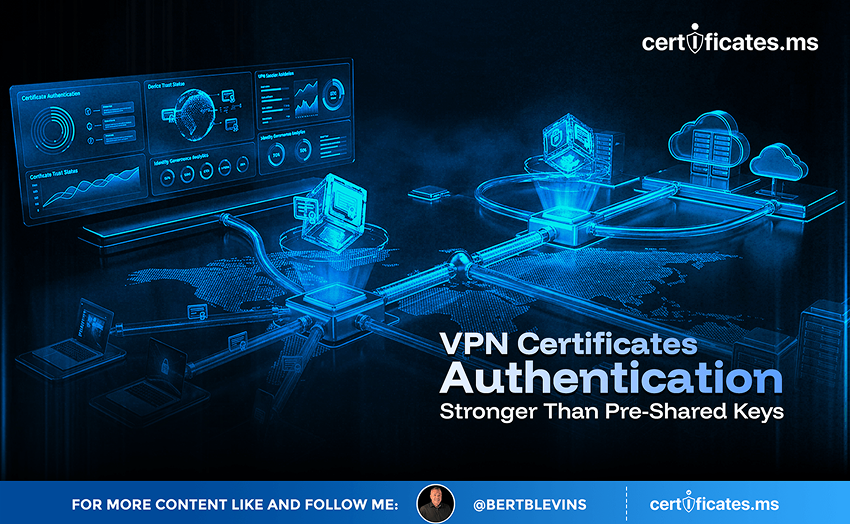
VPN Certificate Authentication: Stronger Than Pre-Shared Keys
Pre-shared keys remain a common way to authenticate VPN connections, largely because they are simple to configure and understand. They are also a genuinely weaker security model than certificate-based authentication, and understanding exactly why is worth walking through directly. This article compares the two approaches and makes the practical case for moving VPN authentication toward certificates.
How Pre-Shared Key Authentication Works, and Where It Falls Short
A pre-shared key is, functionally, a shared password: the same secret value configured on both the VPN client and the server, used to authenticate the connection. This is simple to set up but carries all the same weaknesses as any shared secret. The key must be distributed securely to every device that needs it, revoking access for one specific device or user typically requires changing the key for everyone, and a leaked key, whether through a misconfigured device, a departing employee retaining knowledge of it, or interception, compromises every connection relying on that same shared value until it is rotated.
How Certificate-Based VPN Authentication Changes the Picture
Certificate-based VPN authentication issues each device or user its own unique certificate and private key, tied to a specific identity rather than a value shared across an entire user population. This means revoking one specific user or device’s access is a targeted action, revoking their individual certificate, that does not require touching anyone else’s credentials. It also means a compromised device’s stolen certificate exposes only that one device’s access rather than an entire organization’s VPN, a dramatically smaller blast radius than a leaked pre-shared key represents.
The Phishing Resistance Advantage
Pre-shared keys, like passwords, can be phished, socially engineered out of an unsuspecting employee, or simply guessed if weak. A private key backing a certificate cannot be phished in the same way, since there is no value to type into a fake form; the private key material itself never needs to be entered anywhere by the user, considerably reducing the attack surface for social engineering attempts specifically targeting VPN credentials.
Deploying Certificate-Based VPN Authentication in Practice
Most enterprise VPN solutions, including those from Cisco, Palo Alto, and Fortinet covered elsewhere in this series, support certificate-based client authentication natively, typically through mutual TLS or IPsec configurations that verify a client certificate against a trusted internal CA before granting access. Rolling this out requires an internal PKI capable of issuing and managing client certificates at the scale of the organization’s user and device population, along with integration into whatever device enrollment or onboarding process already exists, so certificate issuance happens automatically as part of standard employee and device provisioning rather than as an additional manual step.
Combining Certificates With Additional Factors
Certificate-based VPN authentication does not have to stand alone. Many organizations pair it with an additional authentication factor, such as requiring the certificate’s private key to be unlocked with a PIN stored on a hardware token, or combining certificate authentication with a separate multi-factor prompt, creating a genuinely layered authentication model that is considerably harder to compromise than either factor alone.
Migrating an Existing Pre-Shared Key Deployment v
Organizations moving from pre-shared key to certificate-based VPN authentication typically run both methods in parallel during a transition period, issuing certificates to users and devices progressively while pre-shared key access remains available as a fallback, then disabling pre-shared key authentication entirely once certificate coverage across the user population is confirmed complete. This mirrors the same parallel-run migration strategy discussed elsewhere in this series for legacy PKI transitions generally.
Certificate-Based VPN Access for AI Agents and Automated Systems
As automated systems and AI agents increasingly need VPN access to reach internal resources on an organization’s behalf, certificate-based authentication extends naturally to these non-human identities as well, giving each automated process its own uniquely revocable credential rather than sharing a single pre-shared key or static credential across every automated system needing VPN connectivity, a pattern that would otherwise recreate the exact blast-radius problem certificate-based authentication was adopted to solve in the first place.
The Countdown Is Already Running: 200 Days, 100 Days, 47 Days
Every certificate conversation in 2026 eventually arrives at the same clock, and it is worth closing on it here. The CA/Browser Forum’s Ballot SC-081v3 is not a proposal under discussion; it is an approved, already-in-motion schedule. Maximum public TLS certificate lifetimes fall from 398 days to 200 days on March 15, 2026. They fall again to 100 days on March 15, 2027. By March 15, 2029, they drop to just 47 days, with domain validation itself needing to be re-proven roughly every 10 days.
Translate that into operational terms and the picture gets stark quickly. An organization currently renewing certificates a few times a year will be handling renewal events on the order of every couple of weeks by the end of this countdown, across every endpoint it operates. Manual tracking, calendar reminders, and a spreadsheet somebody checks once a month will not survive contact with that cadence. What has always been an occasional chore is becoming a continuous, automated operation, whether an organization plans for it or not.
VPN client certificates issued from a private CA are not directly bound by the public certificate lifetime schedule below, but organizations building this out today should still adopt the same short-lived, fully automated renewal discipline the public schedule requires, since it is the same operational pattern that will keep both public and private certificate estates manageable as renewal frequency climbs everywhere.
The 200-day, 100-day, and 47-day milestones are not distant hypotheticals; the first has already arrived. Organizations that build the automation loop now, generating keys, vaulting them securely, brokering issuance across Certificate Authorities through APIs, and rebinding certificates to live endpoints without manual intervention, will meet each deadline without disruption. Organizations that wait will be rebuilding their certificate operations under deadline pressure, with far less room for error and far less time to get it right. The countdown is the call to action. The only real decision left is whether to automate on your own schedule, or on the CA/Browser Forum’s.