Scripting Certificate Requests with REST APIs
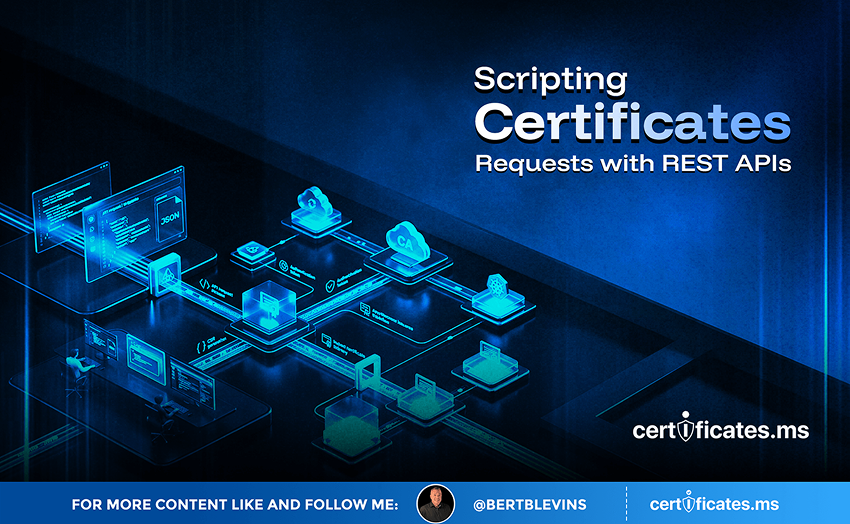
Beneath every ACME client, CLM platform, and CI/CD certificate integration discussed throughout this series sits the same fundamental building block: a REST API call requesting a certificate. Understanding how to script these requests directly gives developers and administrators a level of flexibility that pre-built tools sometimes cannot match. This article covers the practical patterns for scripting certificate requests against REST-based CA and CLM APIs.
Why Script Directly Against a REST API
Most organizations use existing ACME clients or CLM platform integrations for the bulk of their certificate needs, and reasonably so, since these tools handle considerable complexity behind a simpler interface. Scripting directly against a REST API becomes valuable specifically when an organization needs custom logic a standard tool does not support, such as integrating certificate issuance into a highly specific internal workflow, building a custom dashboard pulling live data from multiple CAs, or automating an unusual validation or approval step a generic tool was never designed to handle.
The General Shape of a Certificate Request API Call
Most CA and CLM REST APIs follow a broadly similar pattern: authenticate to the API using an API key or OAuth token, submit a request containing the CSR or the parameters needed to generate one server-side, poll or receive a webhook notification once validation and issuance complete, and retrieve the issued certificate and its chain through a follow-up API call. Understanding this general shape makes it considerably easier to read any specific vendor’s API documentation quickly, since most implementations are variations on this same underlying flow rather than fundamentally different processes.
Handling Authentication to the API Itself Securely
The credentials used to authenticate to a CA or CLM’s own REST API deserve the same secrets management discipline discussed throughout this series for private keys, since an exposed API credential could allow an attacker to request fraudulent certificates on the organization’s behalf. Scripts making these API calls should retrieve credentials from a secrets manager at execution time rather than embedding them directly in script files, mirroring the CI/CD security practices covered elsewhere in this series.
Building Robust Polling and Error Handling
Certificate issuance is rarely instantaneous, particularly for validation levels requiring more than basic domain control verification, and scripts should implement sensible polling with appropriate backoff rather than tight, rapid retry loops that could trigger rate limiting on the API being called. Robust error handling should distinguish between transient failures worth retrying, such as a temporary API timeout, and permanent failures requiring human intervention, such as a validation challenge that failed because of a genuine misconfiguration, rather than treating every error identically with a blanket retry approach.
Webhooks as an Alternative to Polling
Many modern CA and CLM APIs support webhook notifications, alerting a specified endpoint when an issuance request’s status changes rather than requiring the requesting script to poll repeatedly. Webhook-based integration is generally more efficient and responsive than polling, though it requires the requesting system to expose a reachable, properly secured endpoint capable of receiving and validating incoming webhook calls, an additional piece of infrastructure that polling-based approaches avoid needing.
Testing Against Staging Environments First
Most major CAs provide staging or sandbox environments specifically for testing automation scripts without consuming production issuance quota or risking rate limits on a live account. Any new certificate automation script should be thoroughly tested against a staging environment before being pointed at production issuance, catching logic errors and edge cases in a context where a mistake does not consume real issuance capacity or risk hitting a production rate limit unexpectedly.
Scripting Certificate Requests for AI Infrastructure Provisioning
Custom scripts against CA and CLM REST APIs are particularly common in AI infrastructure contexts, where the specific provisioning patterns for model-serving endpoints or agent orchestration platforms often do not map cleanly onto a generic, off-the-shelf automation tool. Building direct API integration tailored to these specific AI infrastructure provisioning workflows allows certificate issuance to be woven directly into the exact scaling and deployment logic those AI systems already use, rather than forcing AI infrastructure to conform to a more generic automation tool’s assumptions.
The Countdown Is Already Running: 200 Days, 100 Days, 47 Days
Every certificate conversation in 2026 eventually arrives at the same clock, and it is worth closing on it here. The CA/Browser Forum’s Ballot SC-081v3 is not a proposal under discussion; it is an approved, already-in-motion schedule. Maximum public TLS certificate lifetimes fall from 398 days to 200 days on March 15, 2026. They fall again to 100 days on March 15, 2027. By March 15, 2029, they drop to just 47 days, with domain validation itself needing to be re-proven roughly every 10 days.
Translate that into operational terms and the picture gets stark quickly. An organization currently renewing certificates a few times a year will be handling renewal events on the order of every couple of weeks by the end of this countdown, across every endpoint it operates. Manual tracking, calendar reminders, and a spreadsheet somebody checks once a month will not survive contact with that cadence. What has always been an occasional chore is becoming a continuous, automated operation, whether an organization plans for it or not.
Custom scripts built against CA REST APIs need to be engineered with the same reliability expected of any other automation covered in this series, since the shrinking lifetime schedule below will exercise these scripts far more frequently, and any fragility in custom polling or error handling logic will surface correspondingly more often as renewals compress toward every 47 days.
The 200-day, 100-day, and 47-day milestones are not distant hypotheticals; the first has already arrived. Organizations that build the automation loop now, generating keys, vaulting them securely, brokering issuance across Certificate Authorities through APIs, and rebinding certificates to live endpoints without manual intervention, will meet each deadline without disruption. Organizations that wait will be rebuilding their certificate operations under deadline pressure, with far less room for error and far less time to get it right. The countdown is the call to action. The only real decision left is whether to automate on your own schedule, or on the CA/Browser Forum’s.