Debugging Certificate Chain Issues in Production
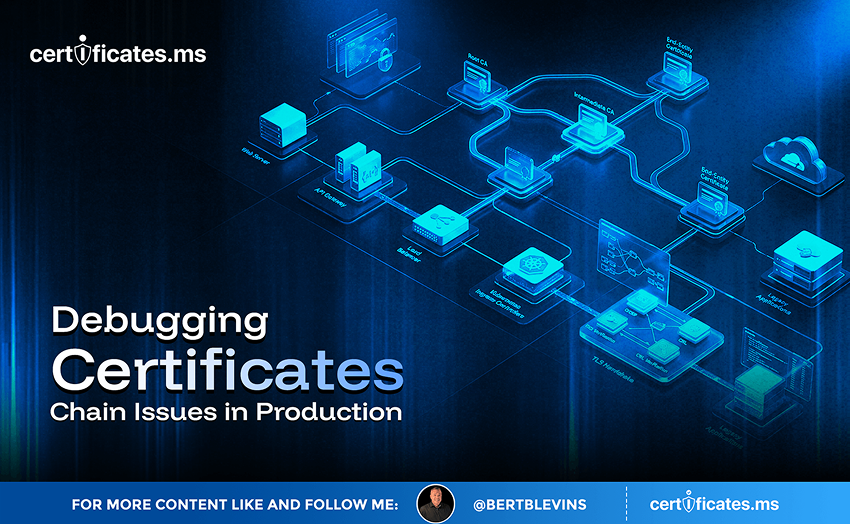
Chain of trust concepts, covered earlier in this series, are straightforward to explain in the abstract, but diagnosing a real chain-related failure in a live production environment, often under real time pressure with customers actively affected, requires a systematic approach rather than guesswork. This article walks through exactly how to debug certificate chain issues methodically when they surface in production.
Start With Independent Verification, Not the Affected Browser
The first and most important debugging step is checking the certificate chain with an independent tool rather than relying on whatever browser or client first reported the problem, since browsers cache intermediates and can mask an incomplete server-side chain configuration, giving a false impression that everything is fine when a fresh client would fail. Command-line tools that connect directly to the server and report the full chain actually being presented, without relying on any cached data, give the most accurate picture of what the server is genuinely sending.
Confirming Whether the Chain Is Actually Incomplete
If independent verification reveals the server presenting only the end-entity certificate without accompanying intermediates, the fix is confirming the correct intermediate certificates for the specific CA and certificate type, and updating the server or load balancer configuration to include the full chain in the correct order, typically end-entity certificate first, followed by intermediates in ascending order toward the root. Different platforms, covered across several articles in this series for network appliances, load balancers, and application servers, each have their own specific configuration syntax for this, but the underlying fix is conceptually identical everywhere.
Diagnosing Name Mismatch Issues
When the error points to a name mismatch rather than a broken chain, the debugging step is directly comparing the hostname the client is actually connecting to against the certificate’s Subject Alternative Name list, which can reveal surprising causes: a load balancer or CDN routing traffic through an unexpected hostname, a recently added domain alias that was never included when the certificate was last issued, or a simple typo in either the certificate’s SAN list or the client’s configuration.
Investigating Client-Side Trust Store Problems
If a chain appears complete and correctly configured on the server side, but validation still fails for a specific subset of clients, the issue may sit on the client side rather than the server: an outdated operating system or browser missing a recently added root certificate, a corporate device with a customized trust store that has fallen out of sync, or in internal environments, a device that never received a private CA’s root certificate in the first place. Isolating whether a chain problem is server-side or client-side early in the debugging process, by testing the same connection from multiple independent client environments, saves considerable time compared to assuming the cause before confirming it.
Handling Intermediate Rotation Issues
Occasionally a CA rotates its intermediate certificates, and servers that had the old intermediate hardcoded rather than dynamically updated can end up presenting a chain that no longer resolves correctly to a currently trusted root. This kind of issue can be particularly confusing since the end-entity certificate itself remains perfectly valid; the problem lies entirely in an outdated intermediate that the CA itself has since replaced. Monitoring CA announcements about intermediate changes, and testing chain validity after any CA-side change, helps catch this specific failure mode before it surfaces as a production incident.
Building Better Detection for Next Time
Every chain-related production incident is an opportunity to strengthen the monitoring and pre-deployment testing discussed elsewhere in this series, specifically by adding automated chain validation as a standard deployment check rather than relying on discovering these issues only after real users encounter them. Organizations that treat each incident as a prompt to close a specific detection gap tend to see the same category of chain issue recur considerably less often over time.
Debugging Chain Issues in AI-Driven, Multi-Hop Architectures
AI-driven architectures, where a request may pass through several chained services, an API gateway, an orchestration layer, multiple backend microservices, before reaching its final destination, can make chain-related debugging considerably more complex, since a certificate issue could exist at any one of several hops rather than a single, simple client-to-server connection. Building clear, hop-by-hop logging and independent chain verification at each stage of these more complex, multi-hop AI architectures makes it considerably easier to isolate exactly where in the chain of services a certificate problem is actually occurring.
The Countdown Is Already Running: 200 Days, 100 Days, 47 Days
Every certificate conversation in 2026 eventually arrives at the same clock, and it is worth closing on it here. The CA/Browser Forum’s Ballot SC-081v3 is not a proposal under discussion; it is an approved, already-in-motion schedule. Maximum public TLS certificate lifetimes fall from 398 days to 200 days on March 15, 2026. They fall again to 100 days on March 15, 2027. By March 15, 2029, they drop to just 47 days, with domain validation itself needing to be re-proven roughly every 10 days.
Translate that into operational terms and the picture gets stark quickly. An organization currently renewing certificates a few times a year will be handling renewal events on the order of every couple of weeks by the end of this countdown, across every endpoint it operates. Manual tracking, calendar reminders, and a spreadsheet somebody checks once a month will not survive contact with that cadence. What has always been an occasional chore is becoming a continuous, automated operation, whether an organization plans for it or not.
Chain-related production incidents will have more frequent opportunities to occur as the schedule below compresses renewal cycles toward every 47 days, making the systematic debugging approach and improved detection discussed throughout this article worth investing in now, well before that increased renewal frequency arrives.
The 200-day, 100-day, and 47-day milestones are not distant hypotheticals; the first has already arrived. Organizations that build the automation loop now, generating keys, vaulting them securely, brokering issuance across Certificate Authorities through APIs, and rebinding certificates to live endpoints without manual intervention, will meet each deadline without disruption. Organizations that wait will be rebuilding their certificate operations under deadline pressure, with far less room for error and far less time to get it right. The countdown is the call to action. The only real decision left is whether to automate on your own schedule, or on the CA/Browser Forum’s.