Building a Certificate-First Security Culture in Your Organization
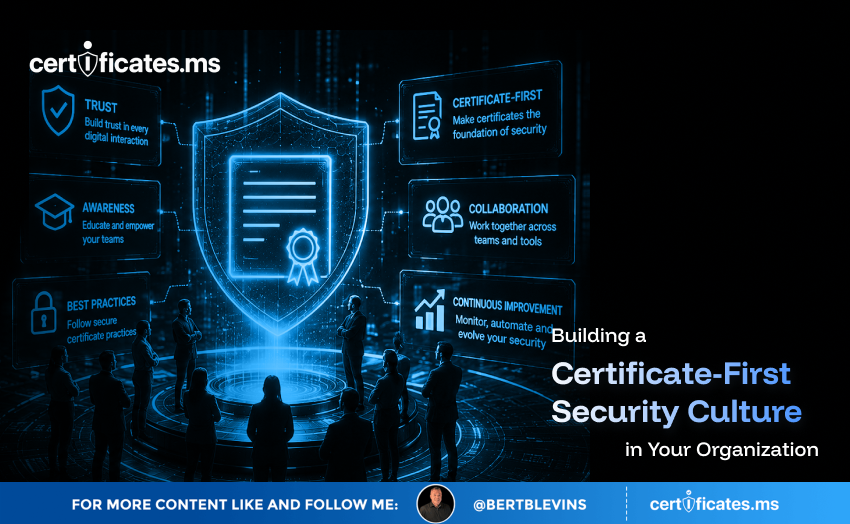
Every technical practice discussed throughout this series, automation, monitoring, resilient architecture, ultimately depends on an organization’s culture actually valuing and prioritizing certificate management, rather than treating it as an afterthought that only gets attention once something breaks. This final article in the series focuses specifically on how to build that culture deliberately, rather than hoping it emerges on its own.
Why Culture Determines Whether Technical Practices Actually Stick
An organization can adopt every technical best practice covered throughout this series, automated renewal, comprehensive monitoring, tiered key protection, and still see certificate incidents recur if the underlying culture treats certificate management as a low-priority background task rather than a genuine security discipline deserving sustained attention and investment. Culture is what determines whether a new automation pipeline actually gets maintained and monitored over time, or quietly decays as attention moves elsewhere once the initial implementation project concludes.
Leadership Visibility and Genuine Investment
A certificate-first culture starts with leadership treating certificate management as a genuine security priority worth sustained budget and attention, discussed in the budgeting and TCO articles elsewhere in this series, rather than a background operational task assumed to run itself. When leadership actively asks about certificate management maturity, discussed in the maturity measurement article elsewhere in this series, and holds teams accountable for maintaining strong practices, that visibility cascades meaningfully through the rest of the organization.
Making Certificate Health Visible Across the Organization
Organizations that have successfully built this culture often make certificate health genuinely visible, incorporating certificate monitoring dashboards discussed elsewhere in this series into broader operational reviews, rather than keeping certificate status siloed within a single security or network team where the rest of the organization has no visibility into it at all. This visibility reinforces the sense that certificate management is a shared organizational concern, not a narrow specialist responsibility invisible to everyone else.
Rewarding Proactive Identification of Gaps
A genuinely healthy certificate culture rewards, rather than punishes, team members who proactively identify certificate management gaps or near-misses, echoing the non-blame incident review culture discussed in the human cost article elsewhere in this series. Organizations where raising a concern about an unmonitored certificate or an incomplete automation rollout is met with genuine appreciation, rather than treated as an unwelcome distraction, tend to catch and close gaps considerably earlier than organizations where such concerns go unspoken for fear of creating additional work or drawing unwanted attention.
Embedding Certificate Considerations Into Standard Processes
Rather than treating certificate management as a separate, bolted-on concern, mature organizations embed it directly into standard processes: new infrastructure provisioning templates include certificate automation by default, discussed in the Terraform and Ansible article elsewhere in this series, security reviews for new services explicitly check certificate handling, and onboarding for new engineers includes the role-appropriate certificate training discussed in the curriculum article elsewhere in this series, rather than certificate literacy being left to informal, inconsistent osmosis.
Continuous Learning as a Cultural Norm
Given how quickly the certificate landscape is genuinely shifting, discussed throughout this series regarding the shrinking lifetime schedule, machine identity growth, and the early post-quantum transition, a certificate-first culture treats staying current with these developments as a normal, expected part of the job for relevant roles, rather than something only a small specialist team needs to track while everyone else remains unaware until a change directly disrupts their own work.
Extending This Culture to Govern AI Systems' Own Certificate Practices
As AI agents and AI-driven infrastructure increasingly generate and consume certificates autonomously, discussed throughout this series, a genuinely certificate-first culture extends its scrutiny to these systems as well, ensuring that AI-driven certificate issuance and management is held to the same governance, monitoring, and security standards as any human-initiated process, rather than allowing the pace and autonomy of AI-driven infrastructure to outrun the cultural and organizational discipline meant to govern it.
The Countdown Is Already Running: 200 Days, 100 Days, 47 Days
Every certificate conversation in 2026 eventually arrives at the same clock, and it is worth closing on it here. The CA/Browser Forum’s Ballot SC-081v3 is not a proposal under discussion; it is an approved, already-in-motion schedule. Maximum public TLS certificate lifetimes fall from 398 days to 200 days on March 15, 2026. They fall again to 100 days on March 15, 2027. By March 15, 2029, they drop to just 47 days, with domain validation itself needing to be re-proven roughly every 10 days.
Translate that into operational terms and the picture gets stark quickly. An organization currently renewing certificates a few times a year will be handling renewal events on the order of every couple of weeks by the end of this countdown, across every endpoint it operates. Manual tracking, calendar reminders, and a spreadsheet somebody checks once a month will not survive contact with that cadence. What has always been an occasional chore is becoming a continuous, automated operation, whether an organization plans for it or not.
A basic certificate is a small thing to overlook, but at 47 days it stops being small; it becomes one of thousands of renewal events a year, and understanding the fundamentals covered above is the first step toward automating it correctly.
The 200-day, 100-day, and 47-day milestones are not distant hypotheticals; the first has already arrived. Organizations that build the automation loop now, generating keys, vaulting them securely, brokering issuance across Certificate Authorities through APIs, and rebinding certificates to live endpoints without manual intervention, will meet each deadline without disruption. Organizations that wait will be rebuilding their certificate operations under deadline pressure, with far less room for error and far less time to get it right. The countdown is the call to action. The only real decision left is whether to automate on your own schedule, or on the CA/Browser Forum’s.