Client Certificate Authentication: Replacing Weak Passwords
Most authentication conversations focus on how a server proves its identity to a client, the padlock icon everyone recognizes. Client certificate authentication flips that relationship, having the client prove its identity to the server using the same cryptographic machinery. This article covers how client certificate authentication works, why it succeeds where passwords routinely fail, and where organizations are deploying it today.
What Client Certificate Authentication Actually Is
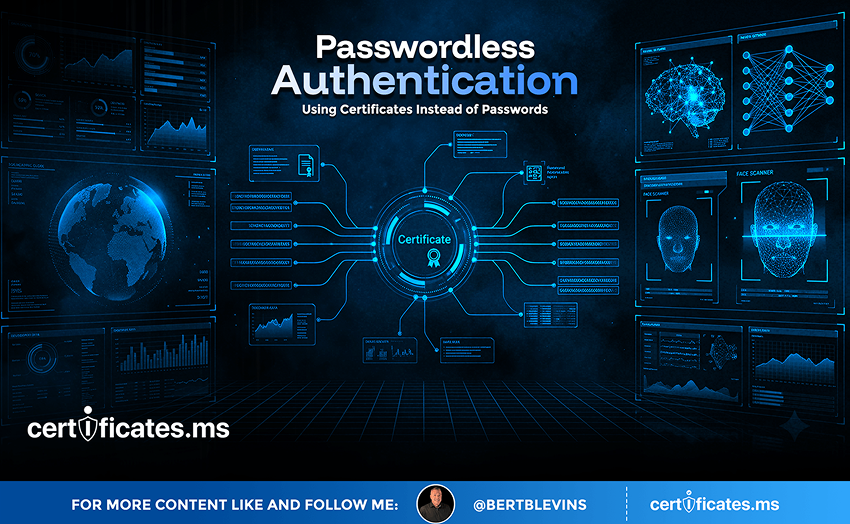
In a standard web connection, only the server presents a certificate, proving to the browser that it is who it claims to be. Client certificate authentication adds the reverse: the client also presents a certificate, and the server verifies it before granting access. This exchange, when both sides authenticate each other, is called mutual TLS. Instead of a username and password, the client proves its identity by demonstrating possession of a private key tied to a certificate the server already trusts.
Why This Beats Passwords on Security Grounds
Passwords are vulnerable to an entire category of attacks that client certificates simply do not suffer from. Phishing pages that harvest passwords are useless against certificate-based authentication, since there is no password to type into a fake login form; the private key never leaves the device or hardware token holding it. Credential stuffing, where attackers try leaked password and username combinations across many services, has no equivalent against certificate authentication, since there is no reusable secret to leak in the first place. Brute-force guessing is similarly irrelevant against a properly sized cryptographic key.
Where Client Certificates Are Already Standard Practice
VPN access is one of the most common deployments, where a device or user certificate authenticates the connection instead of, or alongside, a traditional password. Government and defense environments have long relied on smart cards embedding client certificates for workstation and network login. Financial services and healthcare organizations increasingly use client certificates for high-value API access, where the cost of a compromised credential is severe enough to justify the added deployment complexity. Internal microservice architectures rely on mutual TLS extensively, treating every service-to-service call as an opportunity for both sides to authenticate each other rather than assuming the internal network is inherently trustworthy.
Deployment Considerations
Rolling out client certificate authentication requires establishing or extending a PKI capable of issuing certificates to end users or devices, distributing those certificates securely, often to a hardware token, smart card, or a device’s secure key store rather than a plain file, and building a clear process for what happens when a device is lost, an employee leaves, or a certificate needs to be revoked. None of this is as simple as asking someone to type a password, but the security tradeoff is generally considered well worth the added operational investment for anything protecting genuinely sensitive access.
Combining Client Certificates With Other Factors
Client certificate authentication does not have to be all-or-nothing. Many deployments combine it with an additional factor, such as a PIN required to unlock the private key stored on a hardware token, giving a genuinely strong two-factor experience: something possessed, the certificate and its key, and something known, the PIN unlocking access to it. This combination is considerably more resistant to compromise than a password paired with a one-time code sent by text message, which remains vulnerable to interception and social engineering.
Client Certificates for AI Agents and Automated Clients
The same client-authentication model extends naturally to non-human clients. An AI agent calling an internal API can authenticate using its own client certificate rather than an embedded API key or shared secret, gaining the same phishing-resistance and credential-leak protection that makes client certificates attractive for human users. As organizations grant AI agents access to increasingly sensitive systems, treating the agent as a client that must authenticate with a verifiable certificate, rather than a static token that works indefinitely once obtained, closes off a meaningful attack surface that static credentials have historically left open.
The Countdown Is Already Running: 200 Days, 100 Days, 47 Days
Every certificate conversation in 2026 eventually arrives at the same clock, and it is worth closing on it here. The CA/Browser Forum’s Ballot SC-081v3 is not a proposal under discussion; it is an approved, already-in-motion schedule. Maximum public TLS certificate lifetimes fall from 398 days to 200 days on March 15, 2026. They fall again to 100 days on March 15, 2027. By March 15, 2029, they drop to just 47 days, with domain validation itself needing to be re-proven roughly every 10 days.
Translate that into operational terms and the picture gets stark quickly. An organization currently renewing certificates a few times a year will be handling renewal events on the order of every couple of weeks by the end of this countdown, across every endpoint it operates. Manual tracking, calendar reminders, and a spreadsheet somebody checks once a month will not survive contact with that cadence. What has always been an occasional chore is becoming a continuous, automated operation, whether an organization plans for it or not.
Client certificates issued from public CAs, and the automation supporting them, will need to keep pace with the same shrinking lifetime schedule below, making short-lived, automatically renewed client credentials the practical default rather than a nice-to-have.
The 200-day, 100-day, and 47-day milestones are not distant hypotheticals; the first has already arrived. Organizations that build the automation loop now, generating keys, vaulting them securely, brokering issuance across Certificate Authorities through APIs, and rebinding certificates to live endpoints without manual intervention, will meet each deadline without disruption. Organizations that wait will be rebuilding their certificate operations under deadline pressure, with far less room for error and far less time to get it right. The countdown is the call to action. The only real decision left is whether to automate on your own schedule, or on the CA/Browser Forum’s.