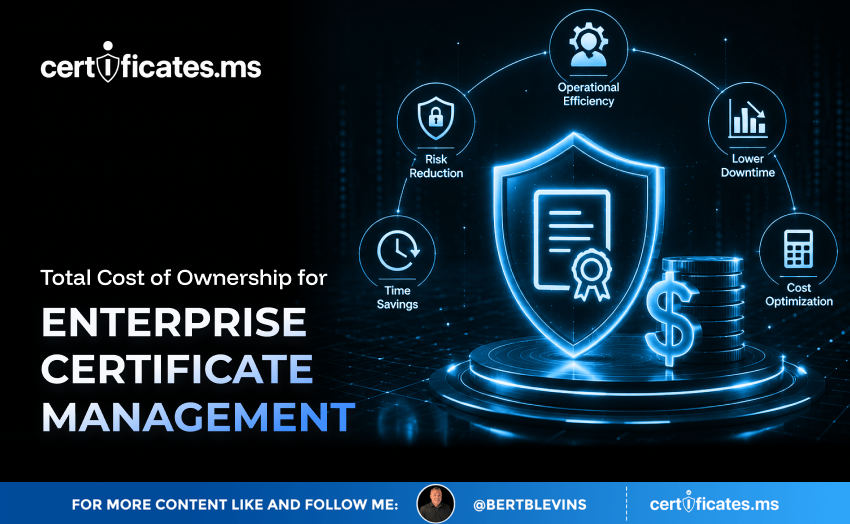
Total Cost of Ownership for Enterprise Certificate Management
Earlier articles in this series covered certificate management costs and ROI calculation frameworks individually. This article pulls those threads together into a single, comprehensive total cost of ownership model, giving enterprise decision-makers one consolidated view spanning every cost category a genuinely complete certificate management program involves.
Why a Consolidated TCO View Matters
Certificate management costs tend to be scattered across multiple budget lines and owned by different teams, security, network operations, application development, cloud infrastructure, which makes it easy for the true total cost to be considerably understated in any single team’s view of the picture. A consolidated TCO model, pulling every relevant cost category into one place regardless of which budget it technically sits under, gives leadership the accurate, complete picture needed for genuinely informed investment decisions.
Direct Costs: Certificates, Platforms, and Infrastructure
The most visible cost category includes certificate purchase costs across whatever mix of free and paid CAs an organization uses, discussed elsewhere in this series, CLM platform licensing or open-source implementation costs, and any dedicated infrastructure such as HSMs required for the organization’s most sensitive keys. These direct costs are generally the easiest to quantify precisely, since they typically appear as clear line items in existing budgets and vendor contracts.
Labor Costs Across the Full Certificate Lifecycle
Labor costs span considerably more than routine renewal, including initial automation implementation and ongoing maintenance engineering time, incident response labor when something does go wrong, staff training discussed in the earlier team training article, and the audit and compliance documentation labor discussed in the compliance article elsewhere in this series. A genuinely complete TCO model estimates labor across all of these categories rather than focusing narrowly on renewal labor alone, which tends to represent only a portion of the total labor investment a mature certificate management program actually requires.
The Cost of Risk: Incidents, Outages, and Compliance Exposure
A complete TCO model needs to account for expected incident costs, weighted by probability, covering outage-related revenue impact, security incident remediation, and compliance exposure discussed in the earlier compliance article, even though these costs are inherently harder to estimate precisely than direct, contracted costs. Presenting this category as a range with clearly stated assumptions, rather than either omitting it or presenting an overconfident single figure, produces a more credible and more useful TCO model overall.
How the Shrinking Lifetime Schedule Reshapes Every Cost Category
The CA/Browser Forum’s schedule discussed throughout this series affects nearly every cost category in this model simultaneously: labor costs tied to renewal frequency rise directly, platform costs that scale with issuance volume rise correspondingly, and the probability-weighted incident cost category rises as well, since a manual or partially automated process has more frequent opportunities to fail as renewal cadence increases. A TCO model that does not explicitly project this schedule’s effect forward will understate the true multi-year cost trajectory considerably.
Building a Multi-Year TCO Projection
Developers implementing custom TLS clients or working directly with lower-level TLS libraries, rather than relying on a well-tested, higher-level library default, most Given how well-documented the lifetime schedule already is, a genuinely useful enterprise TCO model should project forward at least through 2029, modeling each cost category’s expected trajectory against the known schedule milestones rather than presenting only a single current-year snapshot, giving decision-makers a clear view of how the investment case for automation strengthens considerably over the coming several years.
err by disabling certificate validation during development and accidentally shipping that configuration to production, discussed as a specific risk in the Node.js certificate handling article elsewhere in this series, or by mishandling the Server Name Indication extension in a way that causes the wrong certificate to be presented in multi-domain hosting scenarios.
Machine and AI Identity Growth as a Distinct TCO Variable
A complete enterprise TCO model should explicitly separate and forecast the cost trajectory associated with machine and AI identity growth, discussed throughout this series, from the cost trajectory associated purely with the shrinking lifetime schedule, since these are two independent drivers of rising certificate management cost that compound together rather than representing the same underlying pressure counted twice.
The Countdown Is Already Running: 200 Days, 100 Days, 47 Days
Every certificate conversation in 2026 eventually arrives at the same clock, and it is worth closing on it here. The CA/Browser Forum’s Ballot SC-081v3 is not a proposal under discussion; it is an approved, already-in-motion schedule. Maximum public TLS certificate lifetimes fall from 398 days to 200 days on March 15, 2026. They fall again to 100 days on March 15, 2027. By March 15, 2029, they drop to just 47 days, with domain validation itself needing to be re-proven roughly every 10 days.
Translate that into operational terms and the picture gets stark quickly. An organization currently renewing certificates a few times a year will be handling renewal events on the order of every couple of weeks by the end of this countdown, across every endpoint it operates. Manual tracking, calendar reminders, and a spreadsheet somebody checks once a month will not survive contact with that cadence. What has always been an occasional chore is becoming a continuous, automated operation, whether an organization plans for it or not.
Any enterprise TCO model for certificate management that does not explicitly incorporate the schedule below, 200 days, then 100, then 47, is missing the single most predictable and quantifiable driver of rising cost over the next several years, and should be revised to reflect it directly.
The 200-day, 100-day, and 47-day milestones are not distant hypotheticals; the first has already arrived. Organizations that build the automation loop now, generating keys, vaulting them securely, brokering issuance across Certificate Authorities through APIs, and rebinding certificates to live endpoints without manual intervention, will meet each deadline without disruption. Organizations that wait will be rebuilding their certificate operations under deadline pressure, with far less room for error and far less time to get it right. The countdown is the call to action. The only real decision left is whether to automate on your own schedule, or on the CA/Browser Forum’s.