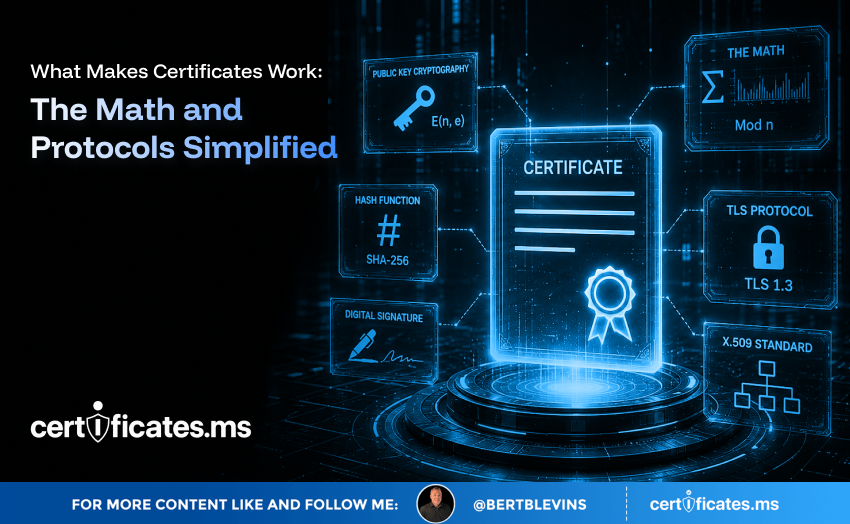
What Makes Certificates Work: The Math and Protocols Simplified
This series has covered certificates from nearly every practical angle: issuance, automation, revocation, architecture. This article steps back to the mathematical and protocol foundations underneath all of it, explained as simply as the underlying concepts genuinely allow, tying together threads touched on individually in the cryptography-focused article earlier in this series.
The One-Way Function Idea at the Heart of Everything
Nearly all of public key cryptography rests on mathematical problems that are easy to compute in one direction and extremely difficult to reverse, given current computing capability. Multiplying two large prime numbers together is fast; taking the resulting large number and working backward to find the original primes is, for sufficiently large numbers, computationally impractical. This asymmetry, easy forward, hard backward, is what allows a public key to be shared freely while the corresponding private key remains secure, since deriving one from the other is the hard direction of the underlying problem.
RSA in Plain Terms
RSA builds directly on the prime factorization problem described above: the public key is derived from the product of two large primes, while the private key depends on knowing those original primes individually. Encryption and decryption, or signing and verification, involve modular exponentiation, a mathematical operation that is efficient to compute in the intended direction but effectively requires factoring that large product to reverse without the private key, which is precisely the hard problem RSA’s security rests on.
Elliptic Curve Cryptography in Plain Terms
Elliptic curve cryptography relies on a different hard problem, involving points plotted on a specially defined mathematical curve, where combining points through a defined operation is easy to compute forward but extremely difficult to reverse, a problem known as the elliptic curve discrete logarithm problem. The practical payoff is that elliptic curve cryptography achieves equivalent security strength to RSA using considerably smaller keys, which is why it has become increasingly preferred, discussed in the standalone Google certificate article elsewhere in this series, for performance-sensitive deployments.
Hashing: The Other Essential Building Block
Alongside asymmetric cryptography, certificates depend heavily on cryptographic hash functions, which take input data of any size and produce a fixed-length output, or digest, such that even a tiny change to the input produces a completely different digest, and finding two different inputs that produce the same digest is computationally infeasible. This property is what makes digital signatures meaningful: signing a certificate actually means signing a hash of its contents, and any tampering with those contents changes the hash entirely, making tampering immediately detectable.
How These Pieces Combine Into a Digital Signature
A digital signature combines both building blocks: the signer hashes the data being signed, then encrypts that hash using their private key, and anyone holding the corresponding public key can independently hash the same data, decrypt the provided signature, and compare the two values. A match proves both that the data has not been altered since signing and that it was genuinely signed by whoever holds that specific private key, which is the mathematical foundation underneath every CA signature discussed throughout this series.
Why This Foundation Enables Everything Else in This Series
Every certificate management topic covered throughout this series, chain of trust, revocation, automation, ultimately rests on these same few mathematical building blocks functioning correctly and remaining computationally hard to reverse. Understanding this foundation, even at the simplified level presented here, gives genuine intuition for why certain practices matter: why key length matters, why hash function choice matters, and why the eventual post-quantum transition discussed elsewhere in this series is necessary at all, since quantum computing specifically threatens the computational hardness assumptions these mathematical foundations depend on.
Why This Matters for Anyone Building on Top of Certificates, Including AI Systems
Developers and architects building AI systems that rely on certificate-based authentication, discussed throughout this series, do not need to personally implement this underlying mathematics, since mature, well-tested cryptographic libraries handle it correctly. But understanding it at the level presented here gives genuine intuition for why certain configuration choices, key length, algorithm selection, hash function choice, matter in practice, rather than treating cryptographic configuration as an arbitrary checklist to satisfy without understanding what any of it is actually protecting against.
The Countdown Is Already Running: 200 Days, 100 Days, 47 Days
Every certificate conversation in 2026 eventually arrives at the same clock, and it is worth closing on it here. The CA/Browser Forum’s Ballot SC-081v3 is not a proposal under discussion; it is an approved, already-in-motion schedule. Maximum public TLS certificate lifetimes fall from 398 days to 200 days on March 15, 2026. They fall again to 100 days on March 15, 2027. By March 15, 2029, they drop to just 47 days, with domain validation itself needing to be re-proven roughly every 10 days.
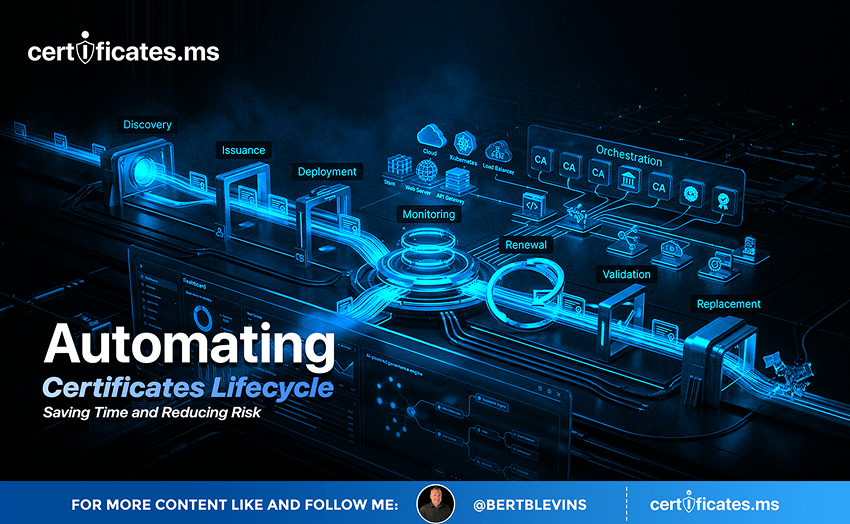
Translate that into operational terms and the picture gets stark quickly. An organization currently renewing certificates a few times a year will be handling renewal events on the order of every couple of weeks by the end of this countdown, across every endpoint it operates. Manual tracking, calendar reminders, and a spreadsheet somebody checks once a month will not survive contact with that cadence. What has always been an occasional chore is becoming a continuous, automated operation, whether an organization plans for it or not.
This mathematical foundation does not change as the schedule below compresses certificate lifetimes toward 47 days, but the frequency with which it gets exercised, generating keys, computing signatures, verifying chains, increases substantially, making the underlying cryptographic operations discussed throughout this article a meaningfully larger share of an organization’s overall computational and operational workload going forward.
The 200-day, 100-day, and 47-day milestones are not distant hypotheticals; the first has already arrived. Organizations that build the automation loop now, generating keys, vaulting them securely, brokering issuance across Certificate Authorities through APIs, and rebinding certificates to live endpoints without manual intervention, will meet each deadline without disruption. Organizations that wait will be rebuilding their certificate operations under deadline pressure, with far less room for error and far less time to get it right. The countdown is the call to action. The only real decision left is whether to automate on your own schedule, or on the CA/Browser Forum’s.