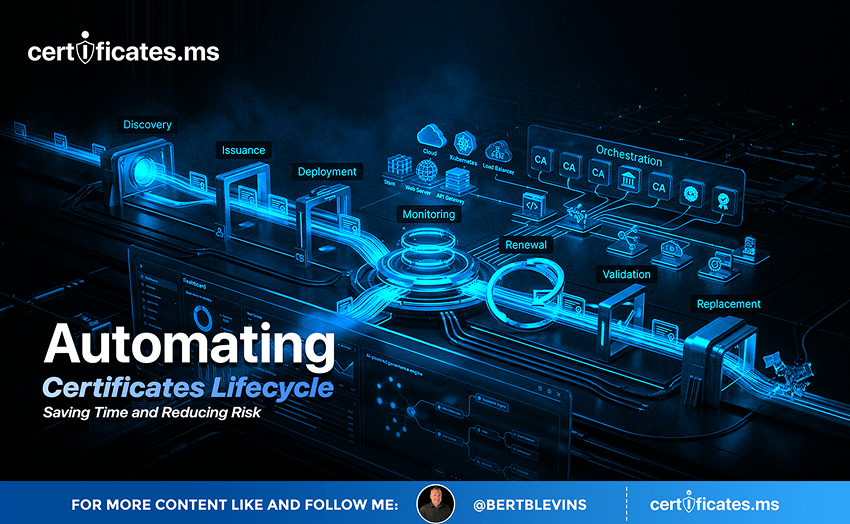
Automating Certificate Lifecycle: Saving Time and Reducing Risk
Every article in this series eventually arrives at the same conclusion: manual certificate management does not scale, and the industry’s own rules are actively forcing the issue. This article focuses squarely on what automating the certificate lifecycle actually looks like in practice, and the concrete time and risk reductions it delivers.
What Automation Actually Covers
A fully automated certificate lifecycle handles every stage without manual intervention: generating key pairs, creating and submitting Certificate Signing Requests, completing domain or organization validation, retrieving the issued certificate, installing it on the correct endpoint, reloading the affected service without downtime, verifying the new certificate is actually being served correctly, and repeating the entire cycle again well before expiration. Automating only part of this chain, for instance issuance but not installation, still leaves a manual bottleneck that can fail under pressure.
The Protocols That Make This Possible
The Automatic Certificate Management Environment protocol, ACME, is the backbone of most modern automation, allowing a server or client to prove domain control and request a certificate programmatically, without a human filling out a form. Complementary protocols like EST and SCEP extend similar automation to constrained and embedded devices. On the internal side, tools built around these protocols, along with dedicated PKI platforms, allow organizations to run their own automated issuance for private certificates using the same programmatic model.
Time Savings in Concrete Terms
Organizations that move from manual to automated certificate management typically report the elimination of nearly all routine renewal labor, freeing skilled staff from repetitive, low-value work to focus on higher-priority security and infrastructure projects. Where a manual renewal might consume an hour of staff time per certificate, an automated pipeline handles the same renewal in the background with no human involvement at all, and that time savings compounds directly with certificate volume and renewal frequency, both of which are climbing across the industry.
Risk Reduction Beyond Time Savings
Automation does more than save labor; it removes the human error that causes a disproportionate share of certificate incidents. A person can forget a renewal date, install a certificate without its intermediate chain, or misconfigure a Subject Alternative Name. A properly built automation pipeline performs the same correct steps every time, consistently, and can be configured to alert immediately if any step fails, rather than silently succeeding with a subtly broken configuration that only surfaces as a problem weeks later.
Building the Automation Pipeline
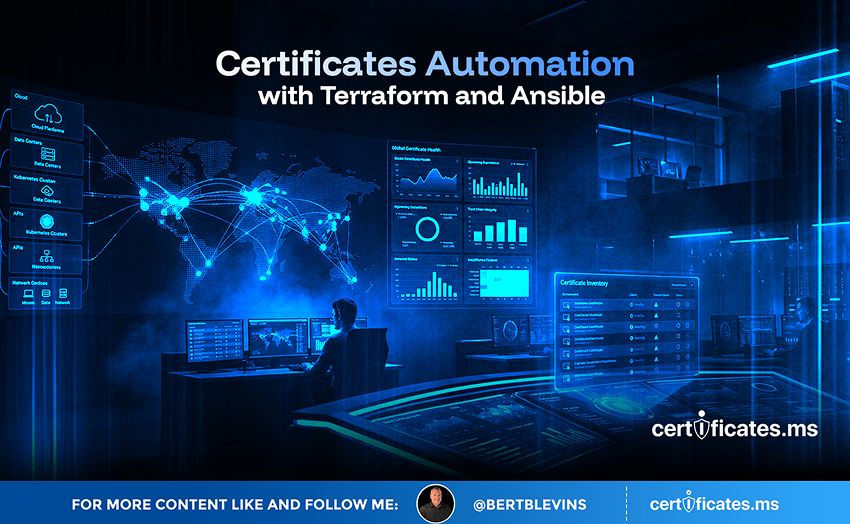
A practical automation rollout typically starts with an inventory of existing certificates and their current renewal processes, followed by prioritizing automation for the highest-risk or highest-volume categories first, often public-facing web services and high-churn internal machine identities. From there, organizations integrate ACME clients or a dedicated certificate lifecycle management platform into their existing infrastructure-as-code and deployment pipelines, so certificate issuance and renewal become just another automated step in how services are deployed, rather than a separate, manually tracked process running on its own calendar.
Automating for AI and Machine Identity Growth
A significant share of the volume driving automation’s urgency comes from machine and AI identities: containers, microservices, and AI agents that spin up and retire far faster than any human-paced process could track. Automation pipelines built for this category need to integrate directly with orchestration platforms, issuing and retiring short-lived certificates in lockstep with the workloads they identify, rather than treating machine and AI identities as an afterthought bolted onto a process originally designed for a handful of long-lived web server certificates.
The Countdown Is Already Running: 200 Days, 100 Days, 47 Days
Every certificate conversation in 2026 eventually arrives at the same clock, and it is worth closing on it here. The CA/Browser Forum’s Ballot SC-081v3 is not a proposal under discussion; it is an approved, already-in-motion schedule. Maximum public TLS certificate lifetimes fall from 398 days to 200 days on March 15, 2026. They fall again to 100 days on March 15, 2027. By March 15, 2029, they drop to just 47 days, with domain validation itself needing to be re-proven roughly every 10 days.
Translate that into operational terms and the picture gets stark quickly. An organization currently renewing certificates a few times a year will be handling renewal events on the order of every couple of weeks by the end of this countdown, across every endpoint it operates. Manual tracking, calendar reminders, and a spreadsheet somebody checks once a month will not survive contact with that cadence. What has always been an occasional chore is becoming a continuous, automated operation, whether an organization plans for it or not.
Full lifecycle automation is not an optional efficiency upgrade once the schedule below takes full effect; it is the only practical way to keep a certificate estate of any meaningful size running as maximum lifetimes compress from 200 days down to 47.
The 200-day, 100-day, and 47-day milestones are not distant hypotheticals; the first has already arrived. Organizations that build the automation loop now, generating keys, vaulting them securely, brokering issuance across Certificate Authorities through APIs, and rebinding certificates to live endpoints without manual intervention, will meet each deadline without disruption. Organizations that wait will be rebuilding their certificate operations under deadline pressure, with far less room for error and far less time to get it right. The countdown is the call to action. The only real decision left is whether to automate on your own schedule, or on the CA/Browser Forum’s.