Passwordless Authentication: Using Certificates Instead of Passwords
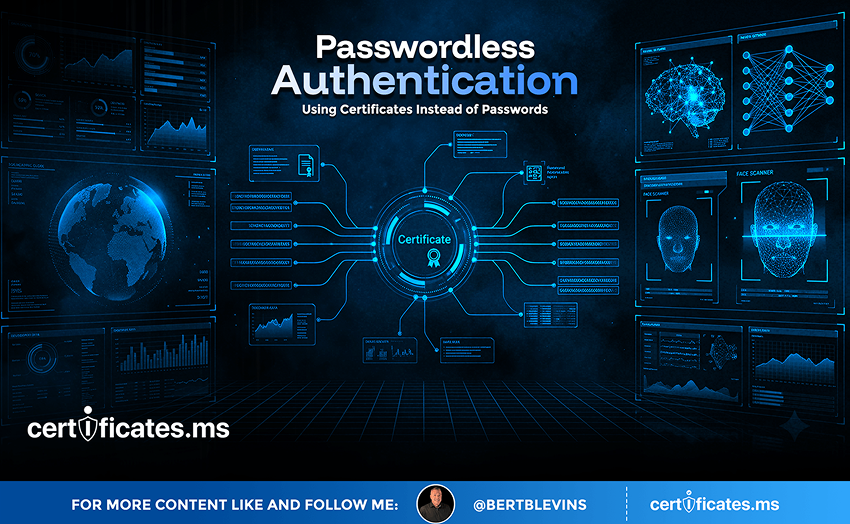
Passwords have been the default authentication method for decades, and they have also been a persistent source of breaches, phishing losses, and help desk tickets for exactly as long. Certificate-based authentication offers a genuinely different approach: instead of proving identity with something memorized, an entity proves identity with something cryptographically possessed. This article looks at how certificate-based passwordless authentication actually works and why organizations are increasingly adopting it.
Why Passwords Keep Failing
Passwords fail in remarkably consistent ways: people reuse them across services, choose weak or predictable ones, fall for phishing pages that harvest them directly, and have them exposed en masse whenever a service they use suffers a data breach. Multi-factor authentication has helped considerably, but it typically bolts an additional step onto a fundamentally weak foundation rather than replacing that foundation outright. Certificate-based authentication takes a different approach entirely, removing the shared secret from the equation.
How Certificate-Based Authentication Works
Instead of typing a password, the authenticating party proves possession of a private key. During authentication, the client signs a challenge issued by the server using its private key; the server verifies that signature using the public key contained in the client’s certificate, which it trusts because that certificate was signed by a CA it recognizes. Because the private key never has to be transmitted, entered into a form, or typed anywhere, there is no password-equivalent secret for a phishing page to intercept or a keylogger to capture. An attacker without physical or digital access to the actual private key simply cannot forge a valid signature, regardless of how convincing a fake login page might look.
Where This Shows Up in Practice
Certificate-based passwordless authentication already underpins several widely used systems. Client-certificate authentication for VPNs replaces or supplements traditional username and password logins with a device or user certificate. Smart cards and hardware security keys, widely used in government and enterprise environments, store a private key that never leaves the physical device, with authentication happening through the same challenge-response signature process. Mutual TLS between services, discussed elsewhere in this series, is essentially certificate-based passwordless authentication applied to machine-to-machine connections rather than human logins.
Advantages Beyond Just Removing Passwords
Certificate-based authentication offers benefits beyond phishing resistance. It can be bound to specific devices, so a stolen password alone is useless without also possessing the specific hardware or key store holding the private key. It integrates cleanly with existing PKI infrastructure many organizations already operate for other purposes. And it produces a clear cryptographic audit trail, since every authentication event is tied to a specific verifiable key rather than a shared secret that could theoretically have been used by anyone who happened to know it.
Practical Challenges to Plan For
Certificate-based authentication is not without friction. Issuing, distributing, and managing certificates for a large user population requires real PKI infrastructure and processes, which is a heavier lift than simply asking users to choose a password. Losing the device holding a private key, or having it stolen, requires a clear revocation and re-issuance process, and organizations need a plan for onboarding and offboarding that keeps pace with employee turnover. None of these challenges are unsolvable, but they are real operational commitments that organizations should plan for deliberately rather than underestimate.
Passwordless Authentication for AI Agents and Service Accounts
The passwordless principle applies just as directly to machine and AI identities as it does to human users, arguably with even stronger justification. An AI agent authenticating with a static API key is, functionally, using the machine equivalent of a password: a shared secret that, if leaked, remains valid until manually rotated. Replacing that with certificate-based or short-lived token-based authentication, tied to a cryptographic key the agent actually holds rather than a string it simply presents, closes off an entire category of credential-leakage risk that has already caused real incidents as AI agents have taken on more autonomous, API-driven responsibilities across enterprise environments.
The Countdown Is Already Running: 200 Days, 100 Days, 47 Days
Every certificate conversation in 2026 eventually arrives at the same clock, and it is worth closing on it here. The CA/Browser Forum’s Ballot SC-081v3 is not a proposal under discussion; it is an approved, already-in-motion schedule. Maximum public TLS certificate lifetimes fall from 398 days to 200 days on March 15, 2026. They fall again to 100 days on March 15, 2027. By March 15, 2029, they drop to just 47 days, with domain validation itself needing to be re-proven roughly every 10 days.
Translate that into operational terms and the picture gets stark quickly. An organization currently renewing certificates a few times a year will be handling renewal events on the order of every couple of weeks by the end of this countdown, across every endpoint it operates. Manual tracking, calendar reminders, and a spreadsheet somebody checks once a month will not survive contact with that cadence. What has always been an occasional chore is becoming a continuous, automated operation, whether an organization plans for it or not.
Passwordless systems built on public certificates inherit the same shrinking lifetime schedule as every other public certificate, which is a genuine advantage here: frequent, automated reissuance is exactly the behavior a strong passwordless authentication system should already have, and the deadlines below simply make that behavior mandatory.
The 200-day, 100-day, and 47-day milestones are not distant hypotheticals; the first has already arrived. Organizations that build the automation loop now, generating keys, vaulting them securely, brokering issuance across Certificate Authorities through APIs, and rebinding certificates to live endpoints without manual intervention, will meet each deadline without disruption. Organizations that wait will be rebuilding their certificate operations under deadline pressure, with far less room for error and far less time to get it right. The countdown is the call to action. The only real decision left is whether to automate on your own schedule, or on the CA/Browser Forum’s.