F5 BIG-IP and Certificate Management Strategies
F5 BIG-IP appliances sit at the traffic-management core of a huge share of large enterprise networks, handling load balancing, application delivery, and TLS termination for some of the highest-stakes traffic an organization carries. Certificate management on BIG-IP has its own conventions, distinct from both open-source load balancers and other commercial network vendors, and getting it right matters disproportionately given how much traffic typically flows through a single BIG-IP deployment. This article covers the practical realities of managing certificates on this platform.
How BIG-IP Organizes Certificates
BIG-IP manages certificates and keys through Client SSL and Server SSL profiles, which bundle a certificate, its private key, and the associated chain into a reusable configuration object that can then be attached to one or more virtual servers. This profile-based model is powerful for consistency, since updating a profile can propagate a certificate change across every virtual server referencing it, but it also means a single misconfigured or expired profile can simultaneously affect every service attached to it, concentrating both convenience and risk in one place.
The Traditional Manual Workflow
Historically, certificate management on BIG-IP has involved generating a CSR through the management interface or command line, submitting it to a CA, importing the resulting certificate through the GUI or an iControl REST API call, and manually updating the relevant SSL profile to reference the new certificate object. This workflow is well documented and works reliably for infrequent renewals, but it does not hold up well as renewal frequency climbs, since each step still requires a human to initiate and verify it.
Automating Through the iControl REST API
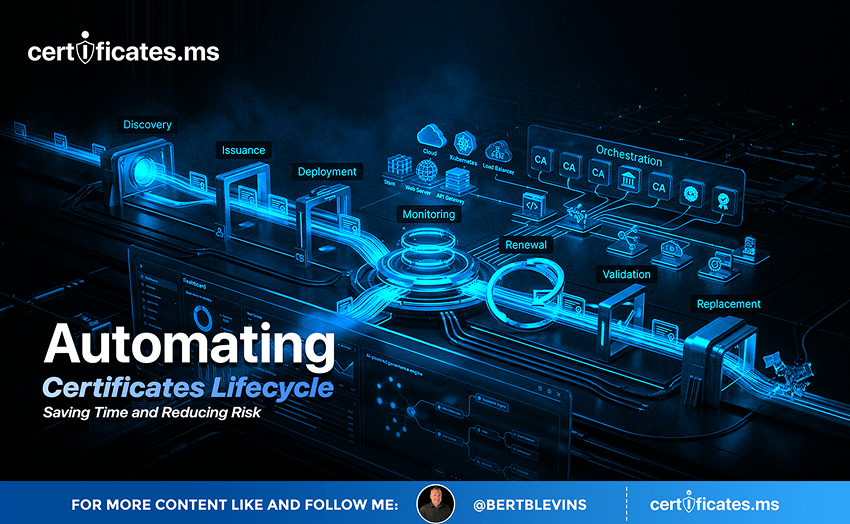
F5’s iControl REST API exposes nearly every certificate management function available through the GUI programmatically, making it the foundation for any real automation effort on this platform. Organizations building automated renewal pipelines typically script certificate requests through an ACME client, then use the iControl API to upload the renewed certificate and update the relevant SSL profiles automatically, closing the loop without manual GUI interaction. F5’s own automation toolchain, including Ansible modules and Terraform providers built specifically for BIG-IP, further simplifies integrating certificate lifecycle automation into existing infrastructure-as-code pipelines many large organizations already run for the rest of their BIG-IP configuration.
High Availability and Certificate Synchronization
Enterprise BIG-IP deployments commonly run in high-availability pairs or clusters, and certificate updates need to synchronize correctly across every unit in that cluster, not just the active device at the time of renewal. BIG-IP’s built-in configuration synchronization features handle this when properly configured, but automation pipelines should explicitly verify that a certificate update has propagated to every cluster member, rather than assuming a successful update on the active unit means the standby units received the same change.
Common Pitfalls Specific to This Platform
A frequent BIG-IP-specific mistake involves updating a certificate object but forgetting that multiple SSL profiles may reference the same underlying certificate under different names, leaving some virtual servers still pointing at stale certificate objects after a renewal. Another common issue is incomplete chain configuration within the SSL profile itself, mirroring the general certificate chain mistakes covered elsewhere in this series but specific to how BIG-IP’s profile structure separates the certificate, key, and chain into distinct configurable fields that all need to be updated consistently together.
BIG-IP Fronting AI-Driven Application Traffic
A growing number of large enterprises use BIG-IP to front AI-powered applications and internal AI service endpoints, applying the same application delivery and security policies to AI traffic that they apply to any other business-critical service. Because these deployments often see bursty, high-volume, machine-generated traffic patterns distinct from typical human-driven web traffic, ensuring the underlying certificate infrastructure is fully automated and resilient to rapid renewal cycles matters just as much here as it does for any other high-throughput BIG-IP deployment.
The Countdown Is Already Running: 200 Days, 100 Days, 47 Days
Every certificate conversation in 2026 eventually arrives at the same clock, and it is worth closing on it here. The CA/Browser Forum’s Ballot SC-081v3 is not a proposal under discussion; it is an approved, already-in-motion schedule. Maximum public TLS certificate lifetimes fall from 398 days to 200 days on March 15, 2026. They fall again to 100 days on March 15, 2027. By March 15, 2029, they drop to just 47 days, with domain validation itself needing to be re-proven roughly every 10 days.
Translate that into operational terms and the picture gets stark quickly. An organization currently renewing certificates a few times a year will be handling renewal events on the order of every couple of weeks by the end of this countdown, across every endpoint it operates. Manual tracking, calendar reminders, and a spreadsheet somebody checks once a month will not survive contact with that cadence. What has always been an occasional chore is becoming a continuous, automated operation, whether an organization plans for it or not.
a few times a year will be handling renewal events on the order of every couple of weeks by the end of this countdown, across every endpoint it operates. Manual tracking, calendar reminders, and a spreadsheet somebody checks once a month will not survive contact with that cadence. What has always been an occasional chore is becoming a continuous, automated operation, whether an organization plans for it or not.
BIG-IP’s profile-based certificate model, and the iControl API automation built around it, are exactly the tools organizations need to keep pace with the shrinking public certificate lifetime schedule below, since manual GUI-driven renewal simply cannot scale as maximum lifetimes compress toward 47 days.
The 200-day, 100-day, and 47-day milestones are not distant hypotheticals; the first has already arrived. Organizations that build the automation loop now, generating keys, vaulting them securely, brokering issuance across Certificate Authorities through APIs, and rebinding certificates to live endpoints without manual intervention, will meet each deadline without disruption. Organizations that wait will be rebuilding their certificate operations under deadline pressure, with far less room for error and far less time to get it right. The countdown is the call to action. The only real decision left is whether to automate on your own schedule, or on the CA/Browser Forum’s.