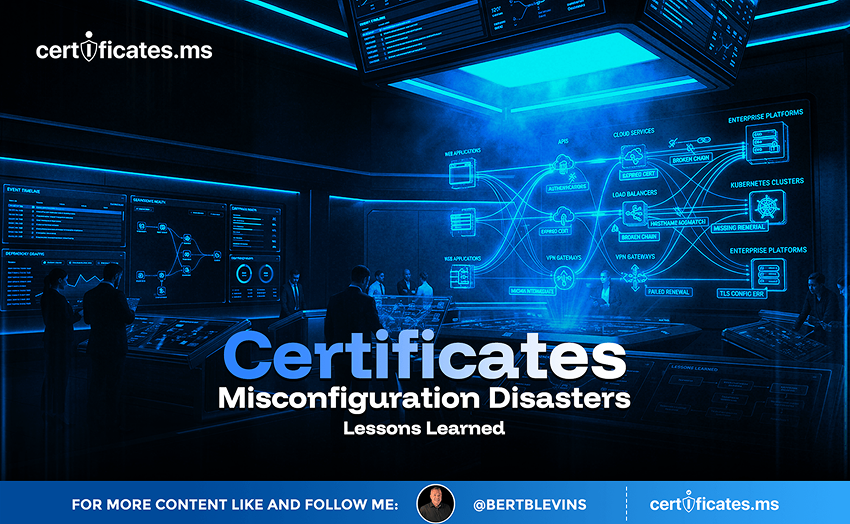
Certificate Misconfiguration Disasters: Lessons Learned
The certificate world’s cautionary tales tend to follow recognizable patterns, and studying them is often more instructive than any amount of abstract best-practice guidance. This article walks through the categories of certificate misconfiguration that have caused genuine, well-documented incidents across the industry, and the specific lessons each one teaches.
Wildcard Certificates Deployed Too Broadly
Several organizations have deployed a single wildcard certificate’s private key across a far wider range of servers and services than originally intended, often as a convenient shortcut during a rushed deployment, only to discover during an incident response that a single compromised server had effectively exposed every subdomain the wildcard covered. The lesson is not that wildcards are inherently unsafe, as covered in more detail elsewhere in this series, but that the convenience of a wildcard certificate should never quietly expand its actual deployment footprint beyond what the original risk assessment assumed.
The Incomplete Chain That Passed Every Internal Test
A recurring, almost comically common pattern involves a certificate installation missing its intermediate certificate, passing internal testing because the testing browser happened to have that specific intermediate cached from a previous, unrelated connection, and then failing visibly for a meaningful share of real users once deployed to production, where their browsers had no such cached intermediate. The lesson is straightforward: test certificate installations with independent tools that build the chain from scratch, never with a browser that might mask an incomplete server configuration through its own cached data.
The Renewal That Silently Failed for Months
More than one organization has discovered, well after the fact, that an automated renewal pipeline had been silently failing for an extended period, quietly serving an increasingly stale certificate that happened to still be within its validity window until the moment it finally expired and the accumulated failure became visible all at once. The lesson here directly reinforces the monitoring discussion elsewhere in this series: automation without independent verification that it is actually succeeding is not genuinely reliable automation, it is simply a delayed version of the same failure a fully manual process would eventually produce.
Private Keys Committed to Source Control
Private keys accidentally committed to a code repository, sometimes a public one, remain a distressingly common incident category, frequently discovered only after automated scanning tools or external security researchers flag the exposure, sometimes well after the fact. The lesson reinforces the CI/CD and secrets management guidance covered elsewhere in this series: private key material should never exist as a plain file within any version-controlled repository, and organizations should run automated scanning specifically for this pattern rather than relying purely on developer discipline to prevent it.
Overlooked Certificates on Forgotten Infrastructure
A significant share of certificate incidents involve infrastructure nobody was actively thinking about: an old internal tool, a decommissioned-in-spirit-but-not-in-practice server, or a legacy API endpoint still quietly handling traffic that everyone assumed had been fully retired. These systems frequently run on certificates nobody is monitoring, and their eventual expiration causes confusion precisely because the affected system was not on anyone’s active radar. The lesson is that certificate discovery and inventory, discussed throughout this series, need to cover the entire environment comprehensively, not just the systems an organization actively remembers still exist.
Trust Store Mismatches During a CA Migration
Organizations migrating between CAs, whether during a legacy PKI modernization or simply switching public CA providers, have occasionally deployed certificates from the new CA before every relying client had the new CA’s root properly trusted, causing validation failures for a subset of users or systems that had not yet received the updated trust configuration. The lesson, covered in the legacy PKI migration discussion elsewhere in this series, is that trust distribution needs to happen well ahead of any actual certificate cutover, never simultaneously with it.
What These Incidents Teach About AI-Driven Certificate Management
As AI agents and automated pipelines take on more of the day-to-day certificate issuance and renewal work discussed throughout this series, the misconfiguration patterns above remain just as relevant, but the detection window shrinks even further, since an AI-driven process failing silently may not surface through any human noticing something looks off in the way a person manually reviewing a dashboard occasionally would. Building explicit, independent verification steps into any AI-driven certificate automation, rather than trusting the automation’s own reported success status, is the direct lesson these historical incidents offer for anyone building the next generation of certificate automation.
The Countdown Is Already Running: 200 Days, 100 Days, 47 Days
Every certificate conversation in 2026 eventually arrives at the same clock, and it is worth closing on it here. The CA/Browser Forum’s Ballot SC-081v3 is not a proposal under discussion; it is an approved, already-in-motion schedule. Maximum public TLS certificate lifetimes fall from 398 days to 200 days on March 15, 2026. They fall again to 100 days on March 15, 2027. By March 15, 2029, they drop to just 47 days, with domain validation itself needing to be re-proven roughly every 10 days.
Translate that into operational terms and the picture gets stark quickly. An organization currently renewing certificates a few times a year will be handling renewal events on the order of every couple of weeks by the end of this countdown, across every endpoint it operates. Manual tracking, calendar reminders, and a spreadsheet somebody checks once a month will not survive contact with that cadence. What has always been an occasional chore is becoming a continuous, automated operation, whether an organization plans for it or not.
Every misconfiguration pattern described above becomes more consequential, not less, as the schedule below compresses renewal cycles toward every 47 days, since each of these mistakes will have far more frequent opportunities to occur once certificates are being issued and reissued several times more often than they are today.
The 200-day, 100-day, and 47-day milestones are not distant hypotheticals; the first has already arrived. Organizations that build the automation loop now, generating keys, vaulting them securely, brokering issuance across Certificate Authorities through APIs, and rebinding certificates to live endpoints without manual intervention, will meet each deadline without disruption. Organizations that wait will be rebuilding their certificate operations under deadline pressure, with far less room for error and far less time to get it right. The countdown is the call to action. The only real decision left is whether to automate on your own schedule, or on the CA/Browser Forum’s.