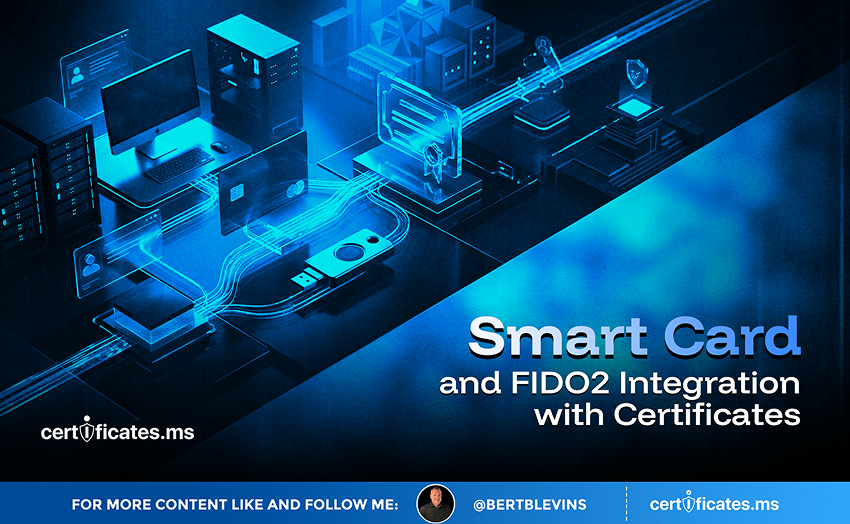
Smart Card and FIDO2 Integration with Certificates
Smart cards and FIDO2 security keys represent two generations of hardware-backed authentication, both built around the same core idea of keeping a private key physically isolated from the device attempting to authenticate. Understanding how each integrates with certificate-based authentication, and where they overlap and diverge, matters for any organization designing strong, phishing-resistant authentication. This article covers both technologies and how they fit alongside the certificate concepts covered throughout this series.
Smart Cards: The Original Hardware-Backed Certificate Store
Smart cards have served as physical certificate stores for decades, particularly in government and defense environments, holding a user’s private key on a tamper-resistant chip that never exposes the key material to the connected computer. Authentication happens through the same challenge-response signature process discussed elsewhere in this series for certificate-based authentication generally, with the card performing the cryptographic signing operation internally and returning only the result, mirroring the same key-isolation principle HSMs apply at a larger infrastructure scale.
How FIDO2 Approaches the Same Problem Differently
FIDO2, and the WebAuthn standard built on top of it, takes a related but architecturally distinct approach, using public key cryptography for authentication without relying on the traditional X.509 certificate chain and CA infrastructure discussed throughout this series. Instead, a FIDO2 authenticator, whether a dedicated hardware key or a device’s built-in secure enclave, generates a unique key pair for each relying service it registers with, and the relying service simply stores the public key directly rather than validating a certificate chain back to a trusted root.
Why This Distinction Matters in Practice
Traditional smart card certificate authentication fits naturally into existing enterprise PKI, since it uses the same certificate issuance, validation, and revocation infrastructure an organization may already operate for other purposes, discussed throughout this series. FIDO2’s per-service key model sidesteps the need for a centralized CA entirely for its own authentication purpose, trading some of the centralized governance and revocation control that PKI provides for a simpler, more phishing-resistant model that has seen rapid adoption particularly for consumer and lighter-weight enterprise authentication scenarios.
Combining Both Approaches in a Layered Strategy
Many organizations use both technologies for different purposes rather than choosing one exclusively: smart cards or PIV cards for scenarios requiring integration with existing enterprise PKI, code signing, email encryption through S/MIME, VPN client authentication, discussed elsewhere in this series, and FIDO2 keys for straightforward, phishing-resistant login to web-based applications and services where the simpler per-service model is a better operational fit.
Deployment Considerations for Both
Rolling out either technology at scale requires a clear provisioning process, issuing cards or keys to users, registering them with the relevant systems, and critically, a well-tested process for handling lost or stolen hardware, since both technologies depend on the physical device remaining in the legitimate user’s possession. Organizations should also plan for backup authentication methods for situations where a user’s hardware is temporarily unavailable, without weakening the overall security model by defaulting too readily to a considerably less secure fallback method.
Hardware-Backed Authentication for Privileged and Administrative Access
Both smart cards and FIDO2 keys are particularly well suited to protecting privileged and administrative access, where the stakes of a compromised credential are considerably higher than for general user access, echoing the same principle discussed elsewhere in this series regarding tiered protection matched to actual risk. Requiring hardware-backed authentication specifically for administrative accounts, even in organizations not ready to roll out hardware authentication broadly, is a targeted, high-value security improvement many organizations can implement relatively quickly.
Hardware Authentication for Human Oversight of AI Systems
As AI agents take on more autonomous responsibility within organizations, the human approval steps that still gate high-stakes AI-driven actions, discussed in the context of the Bybit incident covered in an earlier standalone article, deserve at least as strong an authentication standard as any other privileged access. Requiring smart card or FIDO2 authentication specifically for humans approving significant AI agent actions adds a meaningfully stronger layer of assurance than a password alone would provide for exactly the kind of high-stakes approval step where a compromised credential could cause serious downstream damage.
The Countdown Is Already Running: 200 Days, 100 Days, 47 Days
Every certificate conversation in 2026 eventually arrives at the same clock, and it is worth closing on it here. The CA/Browser Forum’s Ballot SC-081v3 is not a proposal under discussion; it is an approved, already-in-motion schedule. Maximum public TLS certificate lifetimes fall from 398 days to 200 days on March 15, 2026. They fall again to 100 days on March 15, 2027. By March 15, 2029, they drop to just 47 days, with domain validation itself needing to be re-proven roughly every 10 days.
Translate that into operational terms and the picture gets stark quickly. An organization currently renewing certificates a few times a year will be handling renewal events on the order of every couple of weeks by the end of this countdown, across every endpoint it operates. Manual tracking, calendar reminders, and a spreadsheet somebody checks once a month will not survive contact with that cadence. What has always been an occasional chore is becoming a continuous, automated operation, whether an organization plans for it or not.
Smart card certificates issued from enterprise PKI still follow the shrinking public lifetime schedule below wherever they interoperate with public trust, and FIDO2’s simpler per-service key model sidesteps that specific pressure, which is itself a factor worth weighing when choosing between the two approaches for a given authentication use case.
The 200-day, 100-day, and 47-day milestones are not distant hypotheticals; the first has already arrived. Organizations that build the automation loop now, generating keys, vaulting them securely, brokering issuance across Certificate Authorities through APIs, and rebinding certificates to live endpoints without manual intervention, will meet each deadline without disruption. Organizations that wait will be rebuilding their certificate operations under deadline pressure, with far less room for error and far less time to get it right. The countdown is the call to action. The only real decision left is whether to automate on your own schedule, or on the CA/Browser Forum’s.