Teaching Certificate Concepts: 101, 201, 301 Curriculum Outline
This series has, across its full run, effectively built out a complete certificate education curriculum organized around exactly this progression: foundational concepts, intermediate operational depth, and advanced architectural mastery. This article pulls that structure together explicitly, giving trainers and team leads a concrete outline for teaching certificate concepts in a properly sequenced way, referencing where each topic is covered in more depth elsewhere in this series.
Certificate 101: The Foundational Tier
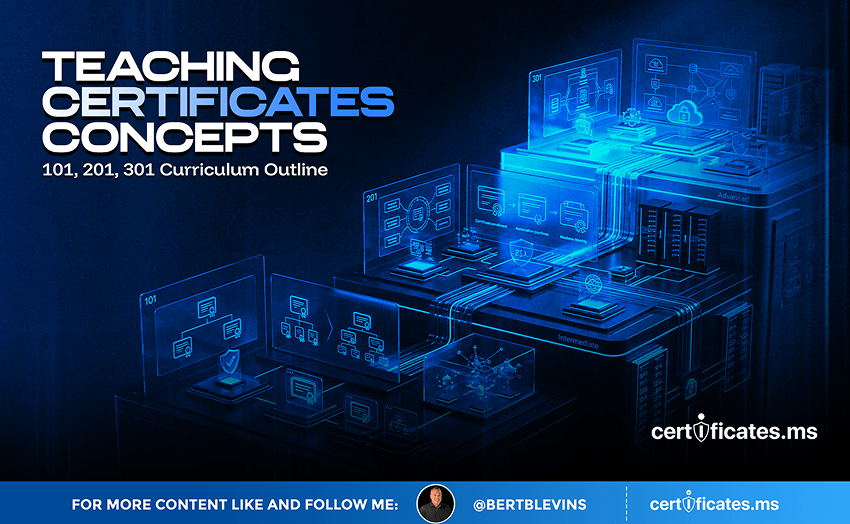
The 101 tier should cover what a digital certificate actually is and the problem it solves, the structure of an X.509 certificate and its key fields, the chain of trust from root to intermediate to end-entity certificate, the difference between Domain, Organization, and Extended Validation, and the basic certificate lifecycle from issuance through renewal and revocation. This tier corresponds directly to the foundational articles covered early in this series and gives learners the conceptual vocabulary needed for everything that follows.
Certificate 201: Building Operational Depth
The 201 tier should build on that foundation with more operationally focused material: Certificate Transparency and its role in detecting misissuance, OCSP versus CRL revocation checking and their respective tradeoffs, key rotation and crypto-agility, and the shift toward short-lived certificates as a deliberate security strategy rather than a compliance burden. This tier corresponds to the intermediate concepts article and related revocation and monitoring content covered earlier in this series, giving learners the depth needed to actually operate certificate infrastructure competently rather than merely understanding it conceptually.
Certificate 301: Advanced Architecture and Resilience
The 301 tier should cover genuinely advanced material: multi-tier CA hierarchy design and segmentation patterns, building resilience and disaster recovery into PKI architecture, HSM integration for the most sensitive keys, and designing for the machine and AI identity growth discussed throughout this series. This tier corresponds to the advanced PKI design and resilient architecture articles covered elsewhere in this series and is appropriately reserved for architects and senior engineers actually responsible for designing an organization’s PKI, rather than being taught broadly to every team member.
Sequencing Hands-On Labs Alongside Each Tier
Consistent with the training guidance discussed in the earlier team training article in this series, each tier should pair conceptual material with hands-on labs: 101 learners generating a key pair and requesting a certificate through OpenSSL, 201 learners setting up automated ACME-based renewal and debugging a deliberately broken chain configuration, and 301 learners designing and standing up a multi-tier private CA hierarchy with appropriate segmentation and testing a simulated failover scenario.
Role-Based Curriculum Assignment
Not every team member needs to progress through all three tiers, echoing the role-based training guidance discussed earlier in this series: help desk and support staff may only need 101-level familiarity plus escalation training, systems administrators and developers typically benefit from progressing through 201, and only architects and senior security staff genuinely need the full 301 tier. Structuring the curriculum with clear entry and exit points for each role avoids over-training some staff while under-training others relative to their actual job responsibilities.
Keeping the Curriculum Current
Given how quickly the industry landscape is shifting, discussed throughout this series regarding the shrinking lifetime schedule and the emerging machine identity and post-quantum considerations, this curriculum should be reviewed and updated at least annually, with particular attention to whether the 201 and 301 tiers still reflect current best practice around automation requirements and the latest industry timeline.
Building AI and Machine Identity Content Into Every Tier
Rather than treating AI and machine identity concepts as a separate, bolted-on module, this curriculum should weave that content into all three tiers naturally, since 101 learners today are just as likely to encounter an AI agent’s certificate as a traditional server’s, and 301-level architects need to design explicitly for this population from the start, discussed throughout this series, rather than treating it as an advanced edge case reserved for the most senior material alone.
The Countdown Is Already Running: 200 Days, 100 Days, 47 Days
Every certificate conversation in 2026 eventually arrives at the same clock, and it is worth closing on it here. The CA/Browser Forum’s Ballot SC-081v3 is not a proposal under discussion; it is an approved, already-in-motion schedule. Maximum public TLS certificate lifetimes fall from 398 days to 200 days on March 15, 2026. They fall again to 100 days on March 15, 2027. By March 15, 2029, they drop to just 47 days, with domain validation itself needing to be re-proven roughly every 10 days.
Translate that into operational terms and the picture gets stark quickly. An organization currently renewing certificates a few times a year will be handling renewal events on the order of every couple of weeks by the end of this countdown, across every endpoint it operates. Manual tracking, calendar reminders, and a spreadsheet somebody checks once a month will not survive contact with that cadence. What has always been an occasional chore is becoming a continuous, automated operation, whether an organization plans for it or not.
Every tier of this curriculum should teach the schedule below as foundational, not supplementary, material, since 101 learners need to understand from day one that certificates now renew far more often than they once did, and 301 architects need to design their entire hierarchy around a world where 47-day renewals are the operating norm.
The 200-day, 100-day, and 47-day milestones are not distant hypotheticals; the first has already arrived. Organizations that build the automation loop now, generating keys, vaulting them securely, brokering issuance across Certificate Authorities through APIs, and rebinding certificates to live endpoints without manual intervention, will meet each deadline without disruption. Organizations that wait will be rebuilding their certificate operations under deadline pressure, with far less room for error and far less time to get it right. The countdown is the call to action. The only real decision left is whether to automate on your own schedule, or on the CA/Browser Forum’s.