Private CA Design Patterns for Large Organizations
A large organization’s internal certificate needs rarely fit neatly into a single, simple CA structure. Different business units have different risk profiles, different geographic regions face different regulatory requirements, and different categories of identity, from employee laptops to AI agents, need meaningfully different issuance policies. This article covers the design patterns large organizations actually use to structure a private CA that can serve all of this coherently, building on the foundational internal CA concepts covered earlier in this series.
Pattern One: Business-Unit-Segmented Intermediates
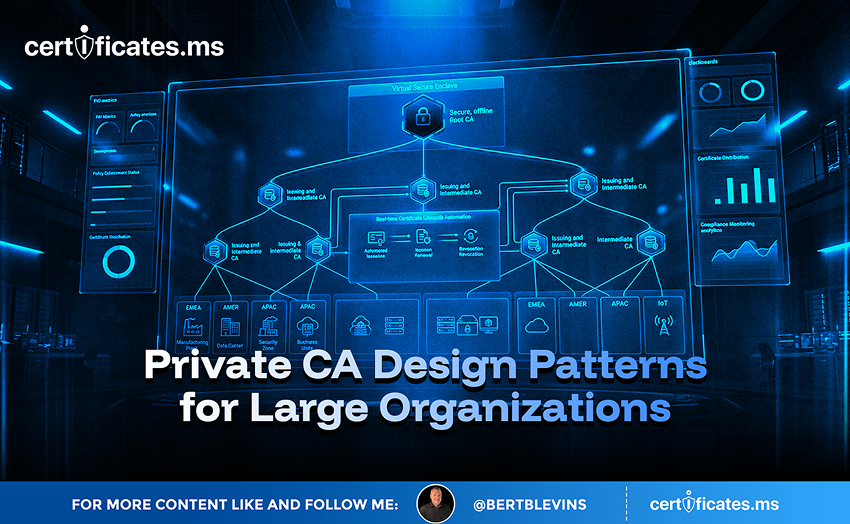
One common pattern dedicates a distinct intermediate CA to each major business unit or division, all signed by a single shared root. This gives each unit operational autonomy over its own certificate issuance and policy details while preserving a single point of ultimate trust anchoring the entire organization. If one unit’s intermediate is ever compromised or needs to be retired, for instance following a divestiture, it can be revoked and replaced without touching any other unit’s certificates or requiring a broader re-establishment of trust across the organization.
Pattern Two: Geography and Regulatory Segmentation
Organizations operating across multiple regulatory jurisdictions, particularly in finance, healthcare, or government contracting, often segment intermediates by region, allowing each region’s issuance practices to align with local regulatory requirements around data residency, key management standards, or specific compliance frameworks, without forcing a single global policy that may not fit every jurisdiction equally well. This pattern also simplifies audits, since a regulator reviewing one region’s certificate practices can be shown a clearly scoped intermediate and its associated policy documentation, rather than needing to untangle a single global CA’s mixed issuance history.
Pattern Three: Identity-Type Segmentation
A pattern that has grown considerably more important as machine and AI identities have proliferated dedicates separate intermediates by identity category: one for traditional servers and network devices, one for employee and device authentication certificates, and one specifically for short-lived machine identities issued to containers, service accounts, and AI agents. This segmentation matters because these categories have fundamentally different validity period needs, different automation requirements, and different risk profiles; mixing them under a single intermediate makes it far harder to apply appropriately different policies to each category without exceptions and workarounds accumulating over time.
Combining Patterns in Practice
Large, complex organizations frequently combine these patterns into a multi-dimensional hierarchy, for example, a root signing regional policy CAs, each of which signs business-unit intermediates, each of which in turn signs identity-type-specific issuing CAs handling the actual day-to-day certificate issuance. This can appear elaborate on a diagram, but the underlying logic is consistent throughout: contain risk at the narrowest reasonable scope, and let each layer’s policy reflect the specific requirements of what it actually governs.
Governance Overhead Scales With Structural Complexity
Every additional layer or segmentation dimension in a private CA hierarchy adds governance overhead: more Certificate Policy documentation, more intermediates requiring their own protection and monitoring, and more coordination required when issuance policy needs to change across multiple segments simultaneously. Large organizations building this kind of structure should invest deliberately in centralized visibility and policy management tooling from the start, since a sophisticated hierarchy without strong central oversight tends to drift into inconsistency exactly because its complexity makes manual tracking impractical.
Designing Explicitly for AI Agent Proliferation
Organizations designing or redesigning a private CA hierarchy today should build the identity-type segmentation pattern in deliberately for AI agents and automated services, anticipating that this category of certificate demand will likely grow faster than any other over the coming years. A dedicated, narrowly scoped intermediate for AI and machine identities, with short default validity periods and API-driven issuance built in from day one, positions an organization to absorb that growth without needing to retrofit the entire hierarchy later once AI-driven certificate volume has already outpaced a structure that was not designed to expect it.
The Countdown Is Already Running: 200 Days, 100 Days, 47 Days
Every certificate conversation in 2026 eventually arrives at the same clock, and it is worth closing on it here. The CA/Browser Forum’s Ballot SC-081v3 is not a proposal under discussion; it is an approved, already-in-motion schedule. Maximum public TLS certificate lifetimes fall from 398 days to 200 days on March 15, 2026. They fall again to 100 days on March 15, 2027. By March 15, 2029, they drop to just 47 days, with domain validation itself needing to be re-proven roughly every 10 days.
Translate that into operational terms and the picture gets stark quickly. An organization currently renewing certificates a few times a year will be handling renewal events on the order of every couple of weeks by the end of this countdown, across every endpoint it operates. Manual tracking, calendar reminders, and a spreadsheet somebody checks once a month will not survive contact with that cadence. What has always been an occasional chore is becoming a continuous, automated operation, whether an organization plans for it or not.
a few times a year will be handling renewal events on the order of every couple of weeks by the end of this countdown, across every endpoint it operates. Manual tracking, calendar reminders, and a spreadsheet somebody checks once a month will not survive contact with that cadence. What has always been an occasional chore is becoming a continuous, automated operation, whether an organization plans for it or not.
Every pattern described above still needs to accommodate the shrinking public certificate lifetime schedule below wherever a private hierarchy issues certificates that must interoperate with public trust, making automation-friendly design a requirement across every segment of a large organization’s CA structure, not just its highest-volume issuing CAs.
The 200-day, 100-day, and 47-day milestones are not distant hypotheticals; the first has already arrived. Organizations that build the automation loop now, generating keys, vaulting them securely, brokering issuance across Certificate Authorities through APIs, and rebinding certificates to live endpoints without manual intervention, will meet each deadline without disruption. Organizations that wait will be rebuilding their certificate operations under deadline pressure, with far less room for error and far less time to get it right. The countdown is the call to action. The only real decision left is whether to automate on your own schedule, or on the CA/Browser Forum’s.