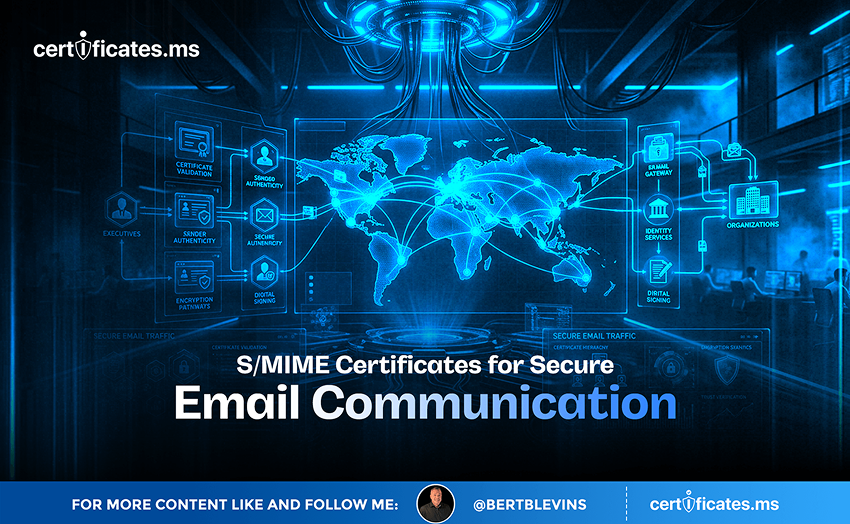
S/MIME Certificates for Secure Email Communication
Email remains one of the least inherently secure communication channels most organizations still depend on daily, transmitted in plain text by default and trivially easy to spoof without additional protection. S/MIME certificates address both of those problems directly, providing genuine encryption and verifiable sender authentication for email. This article covers how S/MIME actually works and where it fits into a modern security strategy.
What S/MIME Actually Provides
Secure/Multipurpose Internet Mail Extensions, S/MIME, uses certificate-based public key cryptography to provide two distinct capabilities for email: digital signing, which lets a recipient verify that a message genuinely came from the claimed sender and was not altered in transit, and encryption, which ensures only the intended recipient, holding the corresponding private key, can actually read the message content. These two capabilities can be used independently or together, and most S/MIME deployments use both by default.
How S/MIME Certificates Differ From TLS Server Certificates
While S/MIME relies on the same underlying X.509 certificate format and public key cryptography as TLS server certificates, the certificates themselves are issued to individual email addresses or users rather than to domains or servers, and they are validated for the specific purpose of email signing and encryption rather than server authentication. A person’s S/MIME certificate ties their public key to their specific email identity, allowing anyone receiving a signed message to verify it actually came from that specific person rather than an impersonator.
Why Sender Verification Matters So Much Right Now
Business email compromise and executive impersonation attacks have grown into one of the more financially damaging categories of cybercrime, frequently relying entirely on a recipient’s inability to verify that an email genuinely came from who it claims to be from. S/MIME’s digital signing capability addresses this directly: a properly signed email displays clear verification in the recipient’s mail client, while an unsigned or improperly signed message impersonating a known S/MIME user stands out immediately rather than blending in indistinguishably with legitimate correspondence.
Deploying S/MIME Across an Organization
Rolling out S/MIME at scale requires issuing certificates to every user who needs to send signed or encrypted email, distributing those certificates to the appropriate mail clients, and establishing a directory or key-exchange mechanism so that senders can obtain a recipient’s public certificate before sending an encrypted message to them. Many enterprise environments integrate this directly with their existing Active Directory or identity provider, automating certificate issuance and distribution as part of the standard employee onboarding process rather than treating it as a separate manual step.
The Practical Friction Points
S/MIME’s most common deployment challenge is not the cryptography itself but key management: a user who loses access to their private key loses the ability to decrypt any previously received encrypted messages unless a proper key escrow or recovery process exists, which many organizations underinvest in during initial rollout. Cross-organizational encrypted email also requires both parties’ mail systems to properly exchange and trust each other’s certificates, which can create friction when communicating with external partners who are not running a compatible or properly configured S/MIME setup themselves.
Where S/MIME Fits Alongside Other Email Security Measures
S/MIME complements rather than replaces other email authentication mechanisms like SPF, DKIM, and DMARC, which operate at the domain and mail-server level rather than the individual message level. A comprehensive email security strategy typically layers domain-level authentication to reduce broad spoofing at the infrastructure level with S/MIME’s message-level signing and encryption for genuinely sensitive or high-risk correspondence, rather than relying on either mechanism alone to cover the full range of email security needs.
S/MIME in an Era of AI-Generated Phishing
AI-generated phishing content has become considerably more convincing and harder for recipients to spot through writing style or obvious errors alone, which makes cryptographic sender verification more valuable, not less. A properly deployed S/MIME environment gives recipients a verification signal that does not depend on spotting subtle inconsistencies in an email’s tone or phrasing, a distinction that matters increasingly as AI tools make those traditional red flags less reliable for both attackers and defenders alike.
The Countdown Is Already Running: 200 Days, 100 Days, 47 Days
Every certificate conversation in 2026 eventually arrives at the same clock, and it is worth closing on it here. The CA/Browser Forum’s Ballot SC-081v3 is not a proposal under discussion; it is an approved, already-in-motion schedule. Maximum public TLS certificate lifetimes fall from 398 days to 200 days on March 15, 2026. They fall again to 100 days on March 15, 2027. By March 15, 2029, they drop to just 47 days, with domain validation itself needing to be re-proven roughly every 10 days.
Translate that into operational terms and the picture gets stark quickly. An organization currently renewing certificates a few times a year will be handling renewal events on the order of every couple of weeks by the end of this countdown, across every endpoint it operates. Manual tracking, calendar reminders, and a spreadsheet somebody checks once a month will not survive contact with that cadence. What has always been an occasional chore is becoming a continuous, automated operation, whether an organization plans for it or not.
S/MIME certificates issued from public CAs are subject to the same shrinking lifetime schedule below as any other public certificate, meaning organizations rolling out or maintaining S/MIME at scale should build automated renewal into the deployment from the start rather than relying on individual users to manually track their own certificate expiration.
The 200-day, 100-day, and 47-day milestones are not distant hypotheticals; the first has already arrived. Organizations that build the automation loop now, generating keys, vaulting them securely, brokering issuance across Certificate Authorities through APIs, and rebinding certificates to live endpoints without manual intervention, will meet each deadline without disruption. Organizations that wait will be rebuilding their certificate operations under deadline pressure, with far less room for error and far less time to get it right. The countdown is the call to action. The only real decision left is whether to automate on your own schedule, or on the CA/Browser Forum’s.