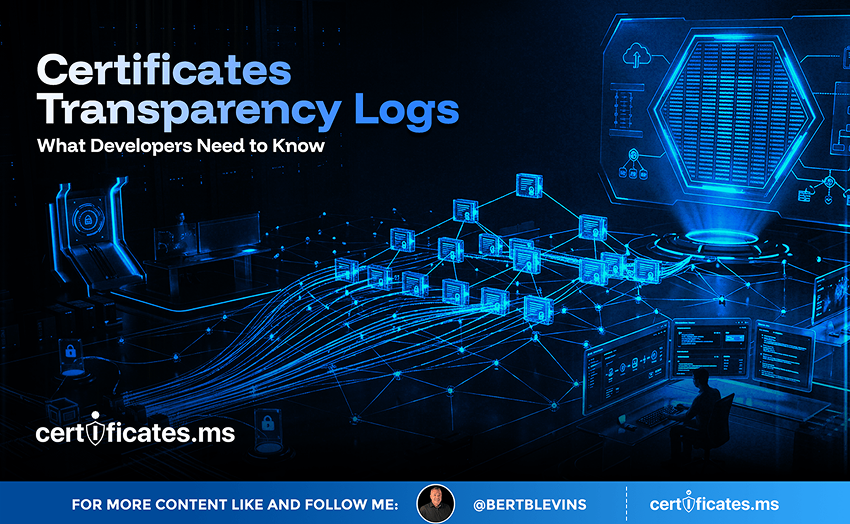
Certificate Transparency Logs: What Developers Need to Know
Certificate Transparency is one of those pieces of internet infrastructure that quietly runs in the background, doing important work most developers never directly interact with, until the day it directly affects them, whether through a surprise notification about an unexpected certificate or a debugging session trying to understand why a browser is behaving unexpectedly. This article covers what developers actually need to know about how Certificate Transparency logs work and why they matter.
The Problem Certificate Transparency Solves
Before Certificate Transparency existed, a Certificate Authority could issue a certificate for any domain, correctly or fraudulently, with no independent, publicly verifiable record of that issuance ever having happened. A domain owner had no reliable way to discover that a CA had issued a certificate for their domain to someone else, whether through validation failure, insider misconduct, or a compromised CA. Certificate Transparency creates append-only, cryptographically verifiable public logs that every publicly trusted CA is required to submit issued certificates to, giving anyone the ability to monitor exactly what certificates have been issued for a given domain.
How the Logs Actually Work
Certificate Transparency logs use a Merkle tree structure, allowing efficient cryptographic proof that a specific certificate is included in the log without needing to download the entire log to verify it. When a CA issues a certificate, it typically obtains a Signed Certificate Timestamp from one or more logs before finalizing issuance, and that timestamp is embedded in the certificate itself, serving as evidence that the certificate has been, or will imminently be, publicly logged. Browsers increasingly require valid SCTs as a condition of trusting a certificate at all, which has made Certificate Transparency compliance a practical requirement for CAs, not an optional best practice.
Why This Matters for Application Developers
Developers building anything that issues or consumes certificates benefit from understanding two practical implications. First, any certificate your organization issues, correctly or by mistake, becomes a matter of public record almost immediately, which means internal naming conventions, unreleased product domain names, or infrastructure details reflected in a certificate’s Subject Alternative Names can become visible to anyone monitoring the logs, a consideration worth factoring into naming choices for anything not yet ready for public knowledge. Second, monitoring Certificate Transparency logs for your own organization’s domains is a genuinely practical, low-cost way to detect unauthorized or accidental certificate issuance quickly, often faster than any other available detection method.
Building or Adopting Certificate Transparency Monitoring
Several free and commercial services continuously monitor Certificate Transparency logs and alert domain owners when a new certificate is issued for their domains, and building a simple custom monitor is also well within reach for a developer comfortable with the relevant public APIs, since several log operators and aggregation services expose queryable interfaces for exactly this purpose. Integrating this kind of monitoring into an organization’s broader security operations, so a misissued certificate triggers the same kind of alert and response process any other security anomaly would, closes a detection gap that manual, ad hoc log-checking cannot reliably cover.
Debugging Certificate Transparency Issues
Occasionally a legitimately issued certificate fails validation in a browser due to a missing or insufficient number of Signed Certificate Timestamps, an issue that can confuse developers who assume the certificate itself must be misconfigured. Understanding that this is a distinct Certificate Transparency compliance issue, separate from the certificate’s own validity or chain configuration, helps narrow down troubleshooting considerably faster than treating every certificate error as a generic chain-of-trust problem.
Certificate Transparency and AI-Assisted Security Monitoring
Certificate Transparency logs have become a rich data source for AI-assisted security monitoring tools, which can process the enormous and continuously growing volume of logged certificates far faster than manual review, flagging patterns such as suspicious domain names resembling a brand’s legitimate domains, unusual issuance velocity, or certificates covering unexpected combinations of subdomains that might indicate a compromised issuance process. Developers building internal security tooling increasingly have the option to tap into this same log data programmatically, pairing it with automated analysis rather than relying purely on third-party monitoring services.
The Countdown Is Already Running: 200 Days, 100 Days, 47 Days
Every certificate conversation in 2026 eventually arrives at the same clock, and it is worth closing on it here. The CA/Browser Forum’s Ballot SC-081v3 is not a proposal under discussion; it is an approved, already-in-motion schedule. Maximum public TLS certificate lifetimes fall from 398 days to 200 days on March 15, 2026. They fall again to 100 days on March 15, 2027. By March 15, 2029, they drop to just 47 days, with domain validation itself needing to be re-proven roughly every 10 days.
Translate that into operational terms and the picture gets stark quickly. An organization currently renewing certificates a few times a year will be handling renewal events on the order of every couple of weeks by the end of this countdown, across every endpoint it operates. Manual tracking, calendar reminders, and a spreadsheet somebody checks once a month will not survive contact with that cadence. What has always been an occasional chore is becoming a continuous, automated operation, whether an organization plans for it or not.
a few times a year will be handling renewal events on the order of every couple of weeks by the end of this countdown, across every endpoint it operates. Manual tracking, calendar reminders, and a spreadsheet somebody checks once a month will not survive contact with that cadence. What has always been an occasional chore is becoming a continuous, automated operation, whether an organization plans for it or not.
As certificate issuance volume climbs under the shrinking lifetime schedule below, Certificate Transparency logs will record a correspondingly larger number of issuance events for every domain, making automated log monitoring an increasingly valuable, and increasingly necessary, complement to the certificate automation already required to keep pace with 47-day renewals.
The 200-day, 100-day, and 47-day milestones are not distant hypotheticals; the first has already arrived. Organizations that build the automation loop now, generating keys, vaulting them securely, brokering issuance across Certificate Authorities through APIs, and rebinding certificates to live endpoints without manual intervention, will meet each deadline without disruption. Organizations that wait will be rebuilding their certificate operations under deadline pressure, with far less room for error and far less time to get it right. The countdown is the call to action. The only real decision left is whether to automate on your own schedule, or on the CA/Browser Forum’s.