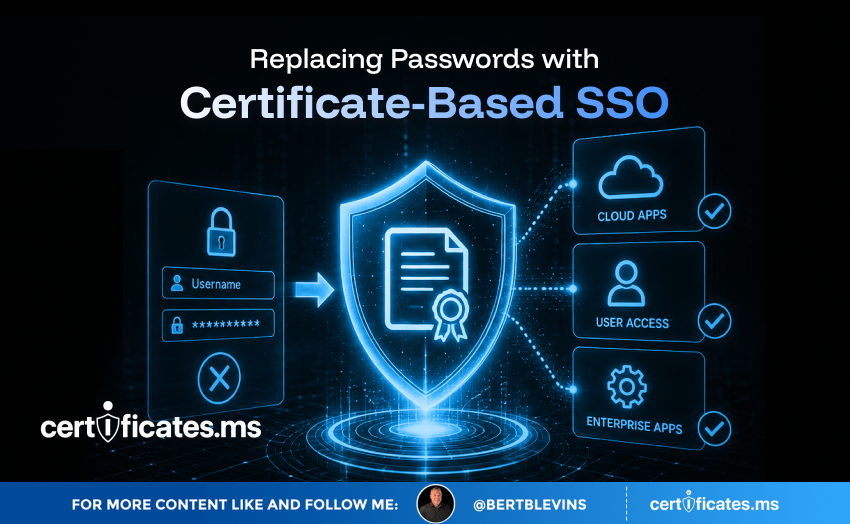
Replacing Passwords with Certificate-Based SSO
Single sign-on has already reduced password fatigue considerably by letting users authenticate once and access many connected applications, but most SSO implementations still rely on a password at that initial authentication step, preserving the exact weakness SSO was meant to reduce. Certificate-based SSO removes that remaining password dependency entirely. This article covers how this works and what it takes to deploy well.
Where Traditional SSO Still Falls Short
Standard SSO protocols, SAML and OpenID Connect among the most common, reduce the number of times a user has to authenticate, but the underlying authentication event itself, when a user first logs into the identity provider, still typically depends on a password, sometimes paired with an additional factor. This means the entire SSO chain, however many connected applications it protects, ultimately rests on the strength of that one initial password-based authentication step, and a compromised password at that single point undermines access to everything the SSO relationship was meant to protect.
How Certificate-Based SSO Changes the Foundation
Certificate-based SSO replaces that initial password-based authentication with the client certificate authentication discussed throughout this series, requiring the user to prove possession of a private key, typically backed by a smart card or a device’s secure hardware, rather than knowing a shared secret. Every downstream application still benefits from the same single sign-on convenience, but the foundation that convenience rests on is now phishing-resistant cryptographic proof rather than a memorized or written-down password.
Certificates Into Existing Identity Providers
Most major identity providers, including those supporting SAML and OpenID Connect, support certificate-based authentication as an alternative or replacement for password-based login, typically configured through the same mutual TLS or smart card integration discussed elsewhere in this series. This means organizations with an existing SSO deployment can often transition to certificate-based authentication at the identity provider level without needing to individually reconfigure every downstream application the SSO relationship already protects.
Handling the Transition From Passwords
Organizations moving to certificate-based SSO typically run both authentication methods in parallel during a transition period, mirroring the parallel-run migration strategy discussed elsewhere in this series for legacy PKI transitions, issuing certificates progressively across the user population while password-based login remains available as a fallback, then disabling password authentication entirely once certificate coverage and user familiarity are confirmed sufficient.
Addressing the Common Objection About User Convenience
A frequent concern is that certificate-based authentication feels less convenient than typing a remembered password, but in well-designed deployments, particularly those using a device’s built-in secure hardware rather than a separate physical token, the actual user experience is often considerably smoother than password entry, requiring only a biometric unlock or a simple PIN to access the locally stored certificate, with no password to remember, type, or periodically change at all.
Recovery and Backup Access Planning
A robust certificate-based SSO deployment needs a clear, secure process for a user who loses access to their certificate-holding device, whether through loss, theft, or hardware failure, discussed in the mobile device certificate article elsewhere in this series, ensuring recovery does not simply default back to a weaker password-based fallback that undermines the entire security improvement the migration was meant to deliver.
Certificate-Based SSO for Human Oversight of AI Systems
As AI agents increasingly operate within enterprise environments requiring human approval for certain actions, discussed elsewhere in this series, certificate-based SSO for the humans providing that oversight is a natural extension of the broader zero trust and hardware authentication principles discussed throughout this series, ensuring the human check on an AI system’s actions is itself backed by strong, phishing-resistant authentication rather than a password that could undermine the entire oversight mechanism if compromised.
The Countdown Is Already Running: 200 Days, 100 Days, 47 Days
Every certificate conversation in 2026 eventually arrives at the same clock, and it is worth closing on it here. The CA/Browser Forum’s Ballot SC-081v3 is not a proposal under discussion; it is an approved, already-in-motion schedule. Maximum public TLS certificate lifetimes fall from 398 days to 200 days on March 15, 2026. They fall again to 100 days on March 15, 2027. By March 15, 2029, they drop to just 47 days, with domain validation itself needing to be re-proven roughly every 10 days.
Translate that into operational terms and the picture gets stark quickly. An organization currently renewing certificates a few times a year will be handling renewal events on the order of every couple of weeks by the end of this countdown, across every endpoint it operates. Manual tracking, calendar reminders, and a spreadsheet somebody checks once a month will not survive contact with that cadence. What has always been an occasional chore is becoming a continuous, automated operation, whether an organization plans for it or not.
Certificates backing an SSO deployment, whether issued from an internal CA or a public one, benefit from the same short-lived, fully automated renewal discipline the schedule below requires industry-wide, ensuring the convenience certificate-based SSO delivers never comes at the cost of a forgotten renewal locking users out unexpectedly.
The 200-day, 100-day, and 47-day milestones are not distant hypotheticals; the first has already arrived. Organizations that build the automation loop now, generating keys, vaulting them securely, brokering issuance across Certificate Authorities through APIs, and rebinding certificates to live endpoints without manual intervention, will meet each deadline without disruption. Organizations that wait will be rebuilding their certificate operations under deadline pressure, with far less room for error and far less time to get it right. The countdown is the call to action. The only real decision left is whether to automate on your own schedule, or on the CA/Browser Forum’s.