Domain Validated (DV) Certificates: Fast and Affordable Security
Domain Validated certificates power a substantial share of the encrypted web, and for good reason: they deliver genuinely strong encryption, near-instant issuance, and in many cases no cost at all. This article covers what DV certificates actually verify, why they have become the default choice for so much of the internet, and where their limitations mean a different validation level is the better call.
What Domain Validation Actually Confirms
Domain Validation confirms exactly one thing: that the entity requesting the certificate controls the domain named in the request. This is typically proven through a DNS record, an email confirmation sent to an address associated with the domain’s registration, or a file placed at a specific path on the web server. Notably, DV validation says nothing about who or what organization is behind that domain; it confirms domain control, not organizational identity, which is the key distinction separating it from Organization Validated and Extended Validation certificates.
Why Speed and Cost Have Made DV the Default
Because DV validation can be fully automated through protocols like ACME, issuance can complete in seconds rather than the days sometimes required for deeper validation tiers, and free CAs offering DV certificates at no cost have removed the financial barrier that once made encryption an added expense many smaller sites skipped entirely. This combination of speed and affordability is largely responsible for the dramatic increase in the overall percentage of web traffic now encrypted, since DV certificates removed both major obstacles, cost and manual effort, that previously discouraged smaller organizations from encrypting their sites at all.
The Encryption Strength Is Identical
A common misconception treats DV certificates as somehow cryptographically weaker than OV or EV certificates. This is not accurate. The actual encryption algorithms, key strength, and protocol security are identical across validation levels; the difference lies entirely in what the CA verified before issuing the certificate, not in the strength of the cryptography protecting the resulting connection. A DV certificate encrypts a connection exactly as strongly as an EV certificate would.
What DV Does Not Tell You
The tradeoff for DV’s speed and simplicity is that it provides no verification of who is actually operating the domain. This has made DV certificates a popular tool for phishing sites, since attackers can obtain a perfectly valid, properly encrypted DV certificate for a look-alike domain in minutes, and the resulting padlock icon looks identical to that of a legitimate site to most users, who often incorrectly interpret the padlock as a broader signal of trustworthiness rather than simply confirmation that the connection is encrypted.
Where DV Is the Right Choice
DV certificates are appropriate for the vast majority of websites and services where the primary requirement is encrypting traffic rather than proving organizational identity: blogs, informational sites, internal tools, development environments, and any service where users are not making significant trust decisions, such as entering payment information, based on the certificate alone. Given DV’s zero or minimal cost and fully automated issuance, there is rarely a good reason to leave any domain unencrypted when DV coverage is this easy to obtain.
Where Something Stronger Than DV Makes Sense
Services handling payment information, sensitive personal data, or anything where users benefit from independently verified organizational identity behind the certificate should generally move up to Organization Validation at minimum. DV’s speed and automation make it an excellent default baseline, but it should not be treated as sufficient for every use case simply because it is convenient.
DV Certificates for AI API Endpoints
Many AI API endpoints, internal microservices, and development environments supporting AI agent workflows are well served by DV certificates, given their high issuance volume, frequent rotation, and generally lower need for organizational identity verification beyond basic domain control. DV’s automation-friendly nature aligns naturally with the high-velocity, programmatic certificate issuance these AI-driven environments already depend on.
The Countdown Is Already Running: 200 Days, 100 Days, 47 Days
Every certificate conversation in 2026 eventually arrives at the same clock, and it is worth closing on it here. The CA/Browser Forum’s Ballot SC-081v3 is not a proposal under discussion; it is an approved, already-in-motion schedule. Maximum public TLS certificate lifetimes fall from 398 days to 200 days on March 15, 2026. They fall again to 100 days on March 15, 2027. By March 15, 2029, they drop to just 47 days, with domain validation itself needing to be re-proven roughly every 10 days.
a few times a year will be handling renewal events on the order of every couple of weeks by the end of this countdown, across every endpoint it operates. Manual tracking, calendar reminders, and a spreadsheet somebody checks once a month will not survive contact with that cadence. What has always been an occasional chore is becoming a continuous, automated operation, whether an organization plans for it or not.
Translate that into operational terms and the picture gets stark quickly. An organization currently renewing certificates a few times a year will be handling renewal events on the order of every couple of weeks by the end of this countdown, across every endpoint it operates. Manual tracking, calendar reminders, and a spreadsheet somebody checks once a month will not survive contact with that cadence. What has always been an occasional chore is becoming a continuous, automated operation, whether an organization plans for it or not.
DV certificates, already the most automation-friendly validation tier, are precisely the category best positioned to absorb the shrinking lifetime schedule below without disruption, since their fully automated issuance model was built for exactly this kind of frequent renewal from the start.
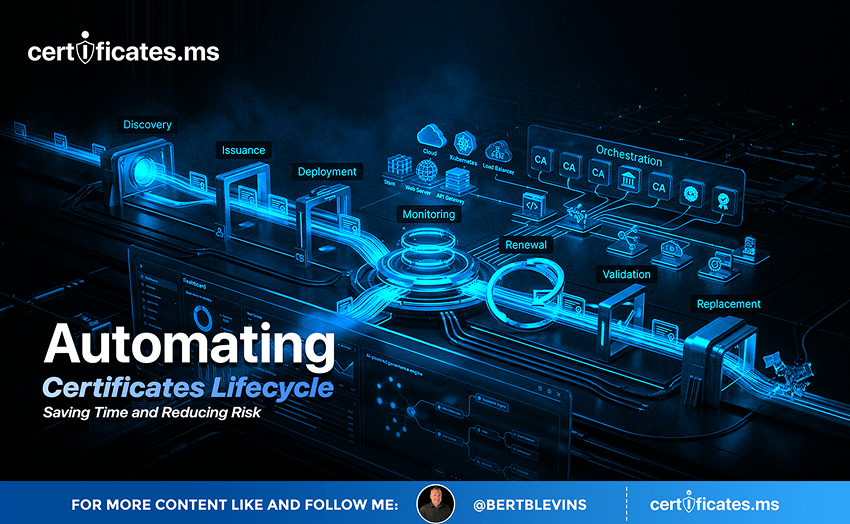
The 200-day, 100-day, and 47-day milestones are not distant hypotheticals; the first has already arrived. Organizations that build the automation loop now, generating keys, vaulting them securely, brokering issuance across Certificate Authorities through APIs, and rebinding certificates to live endpoints without manual intervention, will meet each deadline without disruption. Organizations that wait will be rebuilding their certificate operations under deadline pressure, with far less room for error and far less time to get it right. The countdown is the call to action. The only real decision left is whether to automate on your own schedule, or on the CA/Browser Forum’s.