Self-Signed Certificates: When to Use Them and When to Avoid

Self-signed certificates get a bad reputation, and often deservedly so, but the reputation is more nuanced than a blanket rule of never using them. This article covers exactly what a self-signed certificate is, the genuine situations where it makes sense, and the situations where reaching for one is a mistake waiting to surface.

Wildcard Certificates: Pros, Cons, and Proper Usage

Wildcard certificates offer a tempting shortcut: one certificate covering an entire set of subdomains instead of issuing and managing a separate certificate for each one. That convenience comes with real tradeoffs that are worth understanding clearly before adopting wildcards as a default strategy. This article covers what wildcard certificates actually do, their genuine benefits, and the risks that come bundled with that convenience.

Multi-Domain (SAN) Certificates for Modern Web Architectures

Modern applications rarely live on a single domain anymore. A typical product might span a main website, a separate API domain, a customer portal, and several regional or brand variations, each needing certificate coverage. Multi-domain certificates, built around the Subject Alternative Name extension, exist specifically to handle this reality cleanly. This article covers how they work and where they fit into modern web architecture.

Extended Validation (EV) Certificates: Are They Still Worth It

Extended Validation certificates once carried a distinctive, visible mark of trust in browsers: a green address bar prominently displaying the verified organization\’s name. That visual treatment has largely disappeared, and with it, a fair amount of confusion about whether EV certificates still serve any real purpose. This article examines what EV validation actually involves and whether it remains worth the additional cost and effort today.

Domain Validated (DV) Certificates: Fast and Affordable Security

Domain Validated certificates power a substantial share of the encrypted web, and for good reason: they deliver genuinely strong encryption, near-instant issuance, and in many cases no cost at all. This article covers what DV certificates actually verify, why they have become the default choice for so much of the internet, and where their limitations mean a different validation level is the better call.

IoT Device Certificate Provisioning at Scale

Issuing a certificate to a handful of IoT devices is a manageable task. Issuing certificates to a fleet numbering in the thousands or millions, each device with its own identity, is an entirely different engineering problem. This article focuses specifically on the mechanics of provisioning certificates at genuine IoT scale, building on the broader IoT certificate management concepts covered elsewhere in this series.

Securing MQTT and CoAP with Machine Certificates

MQTT and CoAP are the two lightweight protocols most commonly powering IoT and constrained-device communication, chosen specifically because they minimize overhead on devices with limited processing power and unreliable connectivity. Securing them properly with certificates requires understanding how each protocol handles TLS differently from the standard web traffic most certificate discussions focus on. This article covers exactly that.

Certificate Pinning for IoT and Mobile Applications

Standard certificate validation trusts any certificate that chains back to a recognized root, which works well for the open web but leaves a gap for applications that connect to one specific, known backend and want to trust nothing else, even a technically valid certificate from a compromised or coerced CA. Certificate pinning closes that gap. This article covers how pinning works, where it genuinely helps, and the operational risks it introduces if handled carelessly.

Managing Certificates on Cisco, Palo Alto, and Fortinet Routers

Network security appliances from Cisco, Palo Alto Networks, and Fortinet sit at the center of a huge share of enterprise network infrastructure, and each vendor handles certificate management through its own distinct tooling and conventions. This article covers the practical realities of managing certificates across these three major platforms, building on the general router certificate best practices covered elsewhere in this series.

Load Balancer Certificate Best Practices for HAProxy and NGINX

HAProxy and NGINX power a substantial share of the world\’s load balancing and reverse proxy infrastructure, and both handle TLS termination with their own specific configuration conventions and quirks. This article covers practical certificate best practices for each, building on the broader load balancer SSL termination concepts covered elsewhere in this series.

F5 BIG-IP and Certificate Management Strategies

F5 BIG-IP appliances sit at the traffic-management core of a huge share of large enterprise networks, handling load balancing, application delivery, and TLS termination for some of the highest-stakes traffic an organization carries. Certificate management on BIG-IP has its own conventions, distinct from both open-source load balancers and other commercial network vendors, and getting it right matters disproportionately given how much traffic typically flows through a single BIG-IP deployment. This article covers the practical realities of managing certificates on this platform.

Automating Certificate Renewal with ACME and Certbot

Of all the tools that made automated certificate renewal a practical reality for millions of websites, Certbot is arguably the most widely deployed. Built as the reference client implementation for the ACME protocol, it turned what used to be a manual, once-a-year chore into a background process most administrators never have to think about again. This article covers how ACME and Certbot actually work together, and how to set up renewal automation that genuinely holds up over time.

Let\’s Encrypt in Enterprise Environments: Wins and Challenges

Let\’s Encrypt fundamentally changed the economics of web encryption, and its adoption inside large enterprises has grown well beyond its early reputation as a tool mainly for hobbyist websites and small projects. Using it well at enterprise scale, however, means understanding both what it genuinely excels at and where its design tradeoffs create real friction for large, complex organizations. This article covers both sides honestly.

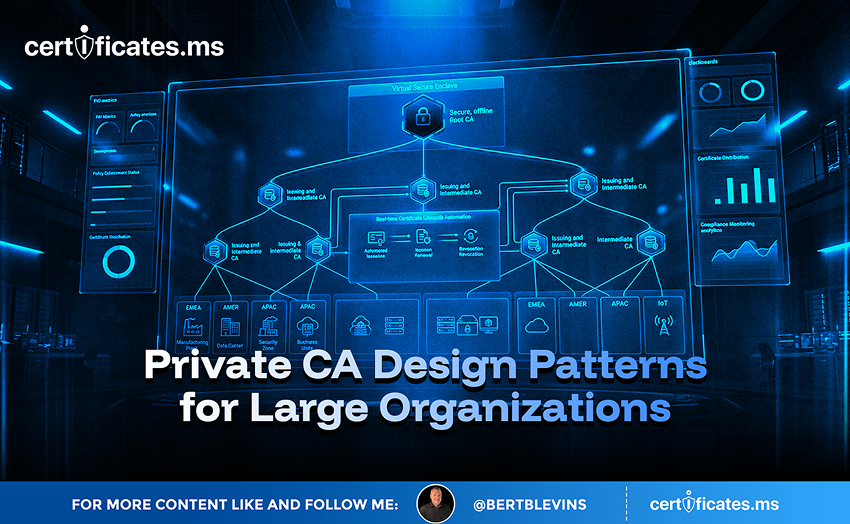
Private CA Design Patterns for Large Organizations

A large organization\’s internal certificate needs rarely fit neatly into a single, simple CA structure. Different business units have different risk profiles, different geographic regions face different regulatory requirements, and different categories of identity, from employee laptops to AI agents, need meaningfully different issuance policies. This article covers the design patterns large organizations actually use to structure a private CA that can serve all of this coherently, building on the foundational internal CA concepts covered earlier in this series.

Certificate Transparency Logs: What Developers Need to Know

Certificate Transparency is one of those pieces of internet infrastructure that quietly runs in the background, doing important work most developers never directly interact with, until the day it directly affects them, whether through a surprise notification about an unexpected certificate or a debugging session trying to understand why a browser is behaving unexpectedly. This article covers what developers actually need to know about how Certificate Transparency logs work and why they matter.