Load Balancer SSL Termination: Certificates Done Right

Load balancers occupy a unique position in most modern application architectures: they are frequently the single place where encrypted traffic from the outside world gets decrypted before being distributed to backend servers. That makes their certificate configuration disproportionately important. Get it wrong, and every application behind the load balancer inherits the weakness. This article covers what SSL termination at the load balancer actually involves and the practices that keep it secure.

Certificate Revocation Lists (CRLs): What They Are and How They Work

Issuing a certificate is only half of the trust equation. The other half is being able to un-trust it before its natural expiration, if something goes wrong. Certificate Revocation Lists are one of the two primary mechanisms, alongside OCSP covered elsewhere in this series, that make revocation actually enforceable rather than merely theoretical. This article explains what a CRL is, how it works, and where it still fits into a modern PKI.

OCSP vs CRL: Modern Certificate Revocation Methods

Every PKI eventually has to answer the same operational question: when a client needs to know whether a certificate has been revoked, how does it find out, quickly, reliably, and without unnecessary overhead? Certificate Revocation Lists, covered in depth elsewhere in this series, were the original answer. The Online Certificate Status Protocol, OCSP, emerged as a more real-time alternative. This article compares the two directly and looks at where each fits in a modern PKI.

When and Why You Should Revoke a Certificate

Revocation is the emergency brake of the certificate world, and like any emergency brake, its value depends entirely on people knowing when to actually pull it. Too hesitant, and a compromised certificate stays trusted far longer than it should. Too trigger-happy, and legitimate services get disrupted unnecessarily. This article covers the situations that genuinely call for revocation, and the reasoning behind each one.

Passwordless Authentication: Using Certificates Instead of Passwords

Passwords have been the default authentication method for decades, and they have also been a persistent source of breaches, phishing losses, and help desk tickets for exactly as long. Certificate-based authentication offers a genuinely different approach: instead of proving identity with something memorized, an entity proves identity with something cryptographically possessed. This article looks at how certificate-based passwordless authentication actually works and why organizations are increasingly adopting it.

Client Certificate Authentication: Replacing Weak Passwords

Most authentication conversations focus on how a server proves its identity to a client, the padlock icon everyone recognizes. Client certificate authentication flips that relationship, having the client prove its identity to the server using the same cryptographic machinery. This article covers how client certificate authentication works, why it succeeds where passwords routinely fail, and where organizations are deploying it today.

The True Cost of Certificate Management: Time and Money Breakdown

Certificates are often budgeted as a line item: the price of the certificate itself. That number is almost always the smallest part of the actual cost. This article breaks down where the real time and money in certificate management goes, and why organizations that only track the purchase price are missing most of the picture.

Hidden Costs of Poor Certificate Management (Downtime, Breaches)

The companion piece in this series covers the visible, budgetable costs of certificate management. This article looks at the costs that rarely show up on a spending report until it is too late: the outages, breaches, and slow-building organizational risk that poor certificate hygiene quietly accumulates.

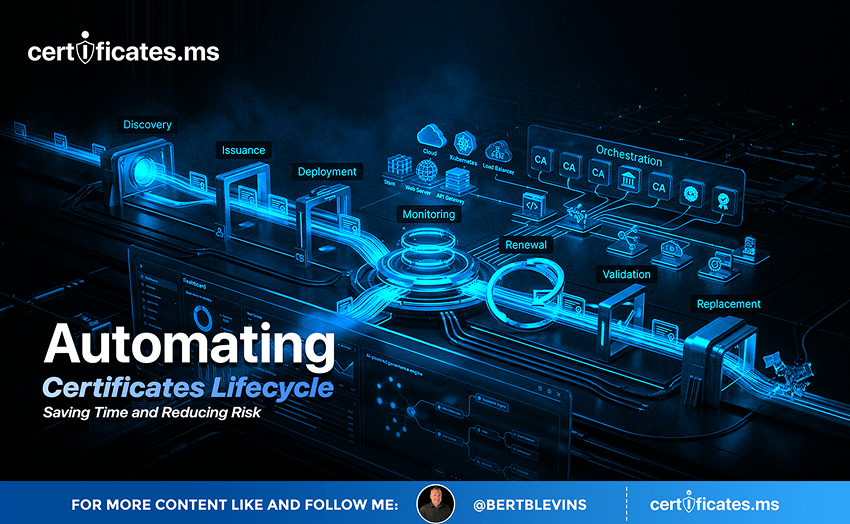
Automating Certificate Lifecycle: Saving Time and Reducing Risk

Every article in this series eventually arrives at the same conclusion: manual certificate management does not scale, and the industry\’s own rules are actively forcing the issue. This article focuses squarely on what automating the certificate lifecycle actually looks like in practice, and the concrete time and risk reductions it delivers.

Programming with Certificates: Using OpenSSL in Python and PowerShell

Understanding certificates conceptually is one skill; actually manipulating them programmatically is another. This article walks through practical, code-level examples of working with certificates in two very different but widely used environments: Python, common in automation scripting and AI tooling, and PowerShell, the standard for Windows-centric infrastructure.

Integrating Certificates in Node.js Applications

Node.js powers a huge share of modern web backends, APIs, and increasingly the orchestration layers behind AI-driven services, which makes handling certificates correctly inside a Node.js application a genuinely common and consequential task. This article covers the practical patterns for working with certificates across Node.js applications, from serving HTTPS traffic to authenticating outbound requests.

Java Certificate Handling: From Keystores to Truststores

Java\’s approach to certificate management looks noticeably different from many other platforms, built around two related but distinct concepts: keystores and truststores. This distinction trips up plenty of developers new to the platform, and getting it wrong is a common source of TLS configuration errors in Java applications. This article breaks down exactly what each one does and how they fit into a working Java application.

Certificate Inclusion in CI/CD Pipelines: Best Practices

Continuous integration and continuous deployment pipelines have become the place where a huge share of an organization\’s software, infrastructure, and increasingly AI-driven services gets built and shipped. Certificates need to move through these pipelines securely and reliably, without becoming either a security liability or a deployment bottleneck. This article covers the best practices for handling certificates well inside CI/CD workflows.

What Makes a Certificate Trusted? The Chain of Trust Explained

A certificate can be cryptographically perfect, correctly signed, properly formatted, and still be worthless if nothing trusts the entity that signed it. Trust in the certificate world is not an inherent property of a certificate; it is inherited, link by link, through a structure called the chain of trust. This article explains exactly how that chain works and what actually makes a certificate trusted.

Root Certificates vs Intermediate Certificates – Key Differences

Root and intermediate certificates work together so seamlessly in practice that the distinction between them often gets glossed over, even by people who work with certificates regularly. Understanding exactly how they differ, and why the distinction exists at all, is essential to understanding how the entire trust ecosystem holds together. This article lays out the key differences and the reasoning behind them.